Additional resources for Active Calculus

I’m excited to announce some recent or ongoing developments related to Active Calculus.

Robert Talbert and Steve Schlicker at GVSU are embarking on a set of supporting videos for chapters 5-8 of the text.  You can see the emerging list of videos from the GVSU Math 202 Calculus 2 playlist on YouTube (over two dozen screencasts already).  It will be the end of the present semester (or possibly the summer) before the list is fully constituted, but it’s wonderful that we’ll have a set of free supporting videos to go with the second half of the text and to complement those already created for Calculus 1.

Eric Sullivan and his colleagues from Carroll College have continued to work on extensions to Active Calculus.  In addition to a Chapter 0 on precalculus material and additional sections on differential equations and infinite series, they have now contributed two more chapters:  one on discrete dynamical systems and difference equations, and a second on some introductory linear algebra, both for use in an introduction to modeling course.  You can see their work in full at the Carroll Mathematics Textbooks site.  They also have a full set of clicker questions to go along with the activities for all 11 chapters of their version of the text.

This spring and summer, I will be working to synthesize and organize some of these supplementary materials on my own site in an effort to make it easier for others who want to use related material like Chapter 0 in their use of Active Calculus.

Posted in Resources, Teaching | Tagged , , | Comments Off on Additional resources for Active Calculus

T v IE: traditional versus interactive engagement

In my last post, I noted that I’ve been doing some interesting reading about the history of calculus instruction and some recent developments.  Earlier today, I gave a talk that summarized much of that reading at the Kansas City Math & Tech Expo, a wonderful conference that happens each fall in KC.  I thought it fitting to post some similar observations here, with a link to my talk slides at the end of this post.  Throughout what follows, the emphasis added in quotes is mine.

One of the quotes in a 1997 publication said the following:  “Courses and materials developed under the aegis of calculus reform emphasize direct experience with methods and processes of inquiry.”  This statement – juxtaposed with two other recent articles I’ve read – make me wonder how fully we have lived into that aspect of the goals and progress of the calculus reform movement.

In David Bressoud’s CSPCC study, one aspect is a survey of over 700 Calculus I instructors.  One summative conclusion is that “Most instructors see themselves as fairly traditional. They view lecture as the best way to teach students and believe that procedural fluency precedes conceptual understanding.”  This struck me as being incongruent with the statement from calculus reform regarding “direct experience with methods and processes of inquiry.”  Then, I read Jerome Epstein’s article in the Notices on the Calculus Concept Inventory (CCI), which observes that “Both the FCI in physics and the CCI in calculus show that traditional instruction has remarkably little effect on basic conceptual understanding, and this has been the greatest shock to faculty. Research dating back more than thirty years has shown that most students emerge from standard introductory courses without a solid grasp of the basic concepts.”

Read that again:  traditional instruction has remarkably little effect on basic conceptual understanding.  The physicists have known this since the late 1980s, but we mathematicians have been slow to acknowledge it.  Indeed, from the survey of calculus instructors, “Most instructors see themselves as fairly traditional. They view lecture as the best way …”

Everyone in our community should read Epstein’s article in full, but here are some important points from it:

– “Hake’s findings [for physics] are striking. They show that [the normalized gain] is independent of the level of the class at entrance … and largely independent of instructor and text. It is, however, strongly dependent on the teaching methodology used.”

– The teaching methodology that promotes the strongest normalized gains Epstein calls “interactive engagement”.  “Interactive Engagement (IE) methods are those designed at least in part to promote conceptual understanding through interactive engagement of students in heads-on (always) and hands-on (usually) activities which yield immediate feedback through discussion with peers and/or instructors.”

– Hake’s findings have been confirmed in independent settings for calculus, too.  This might be seen most prominently in a 1998 study of the University of Michigan’s program — known for its model of interactive engagement — where the overall normalized gains across 51 sections exceeded those at essentially every traditional program.  One of the most striking features of this study was that of the instructors involved in the study, 1/3 of them were new to teaching calculus.  Think about that:  novice instructors, carefully trained to used methods of interactive engagement, were able to lead their students to greater normalized gains that any instructor of any level of experience and expertise using a traditional lecture model.

Novice instructors.  Not lecturing.  Generating demonstrably more conceptual understanding.

So, as I said to my audience today at the Kansas City Math & Tech Expo, I say to all of us: “how ever much interactive engagement we already use, we should use more.”  Interactive engagement moves the needle on conceptual understanding.  And, for lots of reasons that are well established, I submit that conceptual understanding matters far more than procedural fluency.

If you are interested, see the slides from my talk, which include some additional quotes beyond what is in this post, as well as a full list of my bibliographic resources.

Posted in General, Teaching | Tagged , , | Comments Off on T v IE: traditional versus interactive engagement

Looking back to 1987

About 6 months ago, I got invited to give one of two plenary addresses at the upcoming 2014 Kansas City Math Expo, which will occur in three short weeks.  My Saturday talk at the conference is titled “Calculus 2020: A vision for the future.”

One can’t have a vision for the future without an appreciation for the past, so I’ve been doing some reading about the history of calculus instruction generally, and the calculus reform movement in particular.  It’s been fascinating.  Two MAA publications have been immensely helpful:  “Catalyzing a National Community for Reform: NSF Awards 1987-1995” and “Assessing Calculus Reform Efforts”, published in 1997 and 1994, respectively, together provide an insightful history of a wide range of developments.

1987 was a seminal year in the history of calculus instruction (and the year I graduated from high school, sigh).  The Tulane Conference that kicked off calculus reform was in January 1986, and between 1987 and 1995, the NSF awarded $44M in grants to over 350 institutions to impact calculus instruction as part of the “reform” movement.  These grants had a huge impact.  In the former of the two books noted above, the editor (William E. Haver) writes that “Calculus: A Pump, not a Filter sums up the desire of mathematicians that calculus be valuable to students in pursuing their educational and career goals, not a barrier to success.  Courses and materials developed under the aegis of calculus reform emphasize direct experience with methods and processes of inquiry.  Students learn mathematics by doing mathematics, by applying mathematical tools to significant and engaging problems, by working with other students, and by writing about their work.  The use of modern technology adds visual and numeric perspectives to the usual algebraic perspective.”

Later in the volume (still writing in 1997), Haver writes that “calculus students today are making extensive use of modern technology; regularly completing long-term assignments; and frequently participating actively as members of study groups and activity teams.  Ten years ago these activities were virtually unheard of in college mathematics classes.”

Looking back over the span of the last almost 30 years, it’s evident that the calculus reform movement has had a profound impact on collegiate mathematics instruction.  At conferences, in journals, on the NExTList, and with my GVSU colleagues, I am constantly seeing instructional work that reflects the influence of this movement, and certainly not just in calculus.

And yet, some other recent information on calculus instruction is making me wonder if important parts of the reform movement haven’t fully taken root, including those regarding “direct experience with methods and processes of inquiry” and “learn[ing] by doing mathematics … [and] working with other students.”

To see why I’m feeling this way, consider two quotes from David Bressoud’s ongoing “Characteristics of Successful Programs in College Calculus” study:

– “Most instructors see themselves as fairly traditional. They view lecture as the best way to teach students and believe that procedural fluency precedes conceptual understanding.”

– “The emphasis in exams is on computational technique, but almost all instructors have some points devoted to graphical interpretation of central ideas, and most include some complex or unfamiliar problems as well as proofs or justifications.”

(Both quotes are from a post on “The Calculus I Instructor“; you can see a wide range of posts and information related to the project at http://www.maa.org/cspcc/.)

In the near future, I’ll share some thoughts about the Calculus Concept Inventory, and with it some recent work about the considerable impact of “interactive engagement” as an instruction style over “traditional” (i.e. “lecture”) instruction, along with some further reflections on the statements that “most instructors see themselves as fairly traditional” and “they view lecture as the best way to teach students.”

For now, coming up on 30 years since the calculus reform movement started, I’d say to our community: giant steps of progress, still considerable room for growth.



Posted in General, Teaching | Tagged , | 1 Comment

Your (my!) annual vent about textbook costs

College students everywhere are heading to their campus bookstores’ websites to see what their textbooks are going to set them back.  Here are three anecdotes that have gotten me rankled just within the last week or so.

– One of my son’s closest friends is studying nursing at a private university in the upper midwest that has annual tuition of about $34,000 per year.  At dinner the other night, she shared with us that her fall textbook bill was just over $1000 for 5 courses, plus an additional $300 in supplies (nursing scrubs, etc).  So that’s $1300 beyond her already considerable tuition expenses for the term.

– One of my colleagues has a daughter starting this fall at another private university in the midwest, one with similar tuition of around $35,000 annually.  She, too, is studying nursing.  For an introductory chemistry course, the combined bill for textbook and lab manual was $550.  $550!!  An internally customized calculus textbook that couldn’t be purchased anywhere else was over $200.  Total textbook bill for fall semester: nearly $1000.

Keep in mind, the projected average that most schools advertise for books for an entire year is typically around $1100-1200.  Which, of course, is already ridiculously high.  But the two examples above have essentially forced the students to meet the annual average cost in a single semester.

– This final anecdote was relayed to me secondhand.  A prominent author in the mathematical sciences has a popular, longstanding book for an upper-level course in his discipline’s major.  The book is now in its 7th or 8th edition.  When the newest edition came out, the author learned that the text — which has changed little from the last edition to the latest — was retailing for over $200.  The author called the publisher and demanded the price be lowered substantially.  They cut it almost in half.

If publishers can cut the price of a textbook in half, it’s pretty evident what their profit margin is like.

(While we’re here, James Stewart’s 4th edition single variable calculus concepts and context book is still rolling off the Amazon shelves for $218 new, even though the last update to the book was almost 5 years ago.  At least with the longer time period between new editions, there are much more reasonably priced used versions of the text.  The Harvard Calculus text, now in its recently updated fifth edition, is much more reasonably priced at $110 new (softcover).  In light of the chemistry example, $100 for a calculus text seems almost like a good deal, especially when it can be used for two semesters.)

For the first two examples above, I urged my friend and my son’s friend to each write a polite but direct letter to the following three people at their respective universities:  (1) the Provost, (2) the person in charge of enrollment management/retention (likely a vice president or vice provost), and (3) the Director of Admissions.  Those three people understand (a) how fierce the competition is these days to recruit students, (b) how challenging keeping students at one’s university can be, and (c) the simple fact that cost matters.  I think that too often we faculty can be oblivious to all three of those issues.  Personally, I just can’t see a single circumstance in which it is reasonable to pay $550 in textbook fees for an introductory chemistry class, or $1000 in a single semester for books.  Chief executives at universities have to be made aware of this and to enact practices and policies that keep these costs down for students and families.

Count me with Robert Talbert:  it’s time for universities everywhere to “decouple [themselves] from publishing companies.”  We should not be making corporations rich on the backs of our students, especially when nearly every one of these texts is written by someone who is a college professor themselves.  And we absolutely should not be using textbooks as a way to push down our publicly-stated cost of attendance, only to make it up with hidden profits through internally produced, specialized texts with inflated pricetags.


Posted in Costs, General | Tagged , , | 1 Comment

Active Calculus – Print on Demand

I’m excited to announce that the print-on-demand version of Active Calculus has arrived at several online booksellers.  Via the comparison site Fetchbook, you can currently find options with Barnes & Noble and a couple of the non-US Amazon sites (for reasons unclear, the book isn’t yet showing up on Amazon’s US site, though it will soon). The best current price is $15.70 on Barnes & Noble, and with $3.99 for shipping, you can get a copy sent to you for under $20.  We have set the price so that David, Steve, and I receive no royalties whatsoever.  There is a small fee included to cover the ISBN and the modest expenses incurred by Orthogonal Publishing, and of course the printer (Ingram Books) also makes some money for their work.

As always, the .pdf of the text remains free and can be obtained via the GVSU ScholarWorks website.  Info on the activities workbooks can be found at my personal download page.

Posted in Uncategorized | Comments Off on Active Calculus – Print on Demand

Active Calculus – Print on Demand — almost here

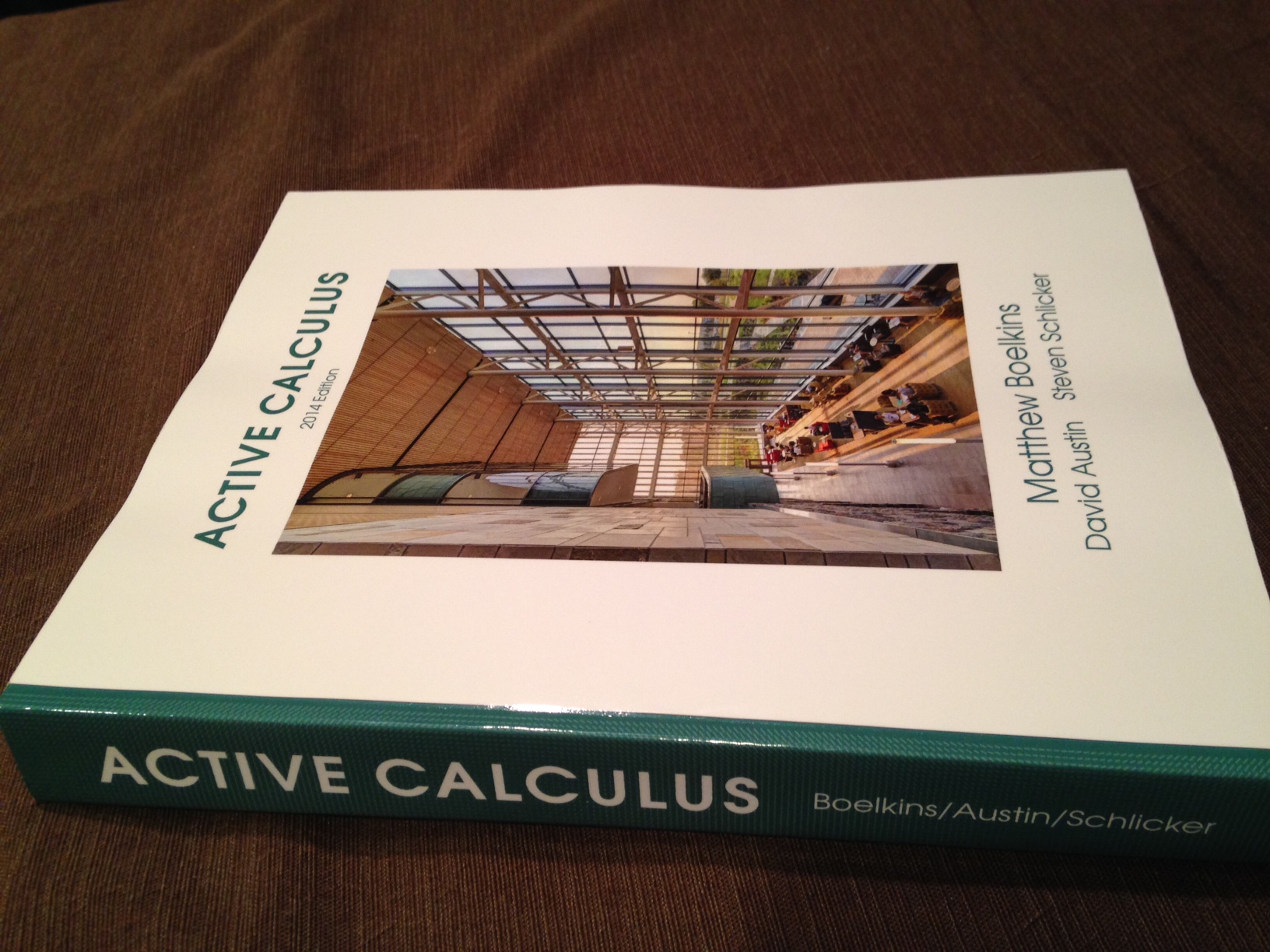
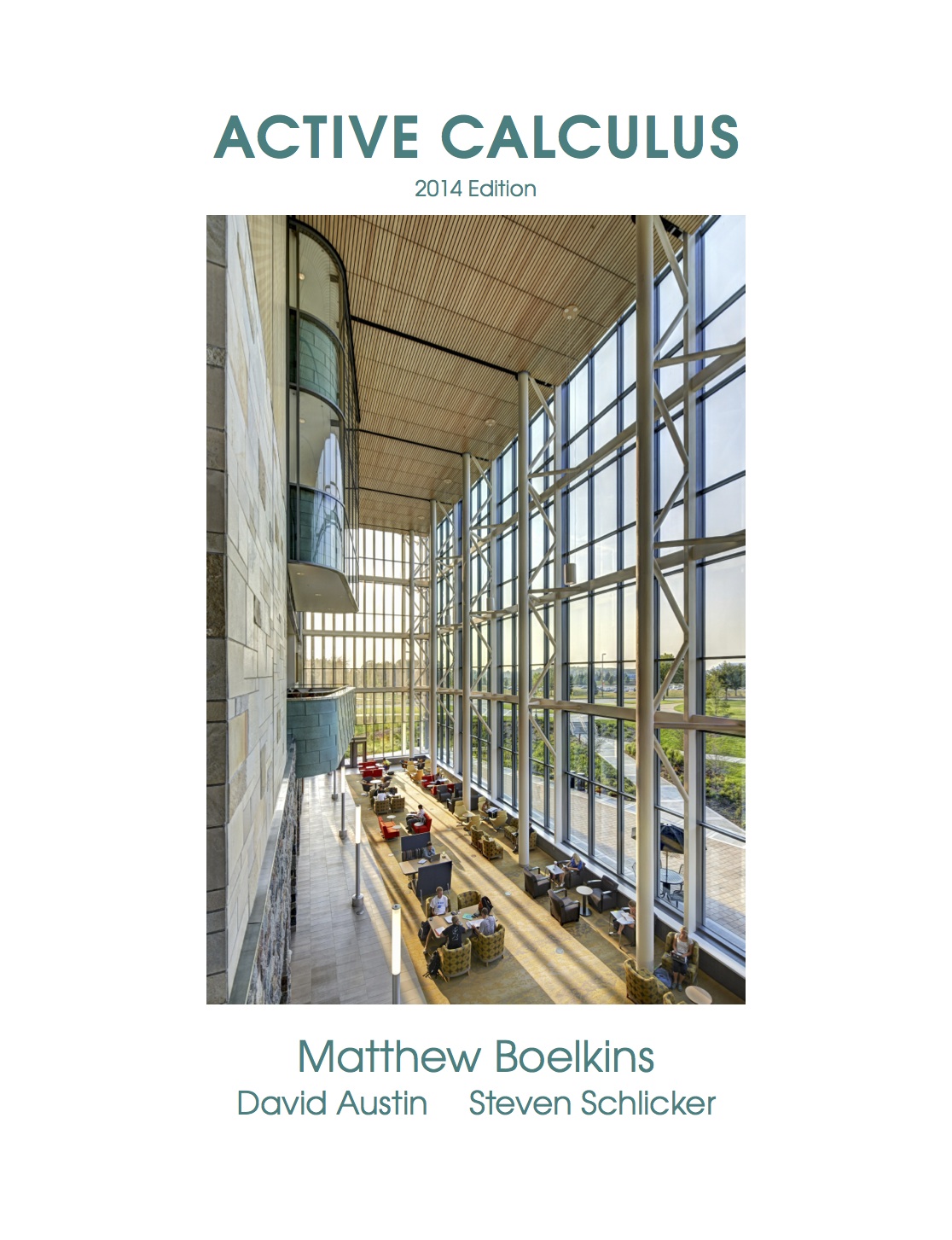
In my mail today, I got a printed copy of the proof for the book.  It was incredibly fun to see the text go from its purely electronic format and the planned cover image

frontcover-JPG

and see it actually become the print copy, lying on my dining room table in 3D:

AC-POD

More details to follow as soon as the link for print-on-demand is live.  Particular thanks go out to Lon Mitchell and his company, Orthogonal Publishing, for all of his efforts to get the book from electronic .pdf to this printed form.  We have an ISBN, too: 978-0-9898975-3-2.

Posted in Editing, Publicity, Publishing | Tagged , , | Comments Off on Active Calculus – Print on Demand — almost here

Carroll College: Clicker Questions and Chapter Zero for Active Calculus

One of the most enjoyable aspects of this free and open textbook project has been all of the new friends I’ve made in the mathematics community.  I just got to see several of them in Portland at Mathfest, including Eric Sullivan of Carroll College in Helena, MT.

As we caught up in person, Eric shared some exciting updates from his department.  In addition to choosing to adopt Active Calculus as their calculus textbook at Carroll, they have developed several additions:  a 6-section “Chapter 0” that provides a review of key precalculus topics, several new sections on differential equations for use in their modeling course (in Chapter 7), and a concluding section (for Chapter 8) on the “Functional DNA” perspective on Taylor series that was coined by Travis Kowalski. (By the way, you can read Travis’s outstanding article in PRIMUS, a college math teaching journal for which I am associate editor.)

Besides these fine additions to the actual text itself, Eric and his colleagues have incorporated a full set of clicker questions along with the activities workbook, building a version of the activities workbook that has the clicker questions included in print.  These clicker questions were originally developed as part of two NSF-funded projects at Carroll (MathQuest and MathVote), which you can investigate further at http://mathquest.carroll.edu/.

In the not distant future I expect to have these additional resources posted in some form on the Active Calculus site I maintain; for now you can see them for yourself at the Carroll math department’s home page for the free texts they are using.  Be sure to check out the links to the first two .pdf files there, which are the expanded version of the text and the activities workbook with clicker questions, respectively.

When I started this project (initial planning in fall 2010), I had a fuzzy vision for the possibility of something like this:  building not just a free text, but one that others could take and modify/adjust/adapt to better serve their local purposed.  I’m grateful to Eric and his colleagues (Kelly Cline, Phil Rose, John Scharf, & Ted Wendt) for their work and contributions here, resulting in this fine example of how a department can customize the text.

Posted in Editing, Publicity, Resources | Tagged , , , , | 1 Comment

Updated version: Active Calculus 2014

Recently I shared news that I’ve been working on a print-on-demand version of the text.  Lon Miller of Orthogonal Publishing and I are in the final stages of that project, and expect by the end of the week of August 11 to be able share the link to order a copy and information about cost.  For now, I’m pleased to share information about the updated e-version and the new URL from which it can be downloaded.

The newest version has a cover image now (to accompany the full cover that will be part of print-on-demand), and I have also corrected all of the errors that were identified between January 1 and July 30.  As always, I welcome hearing from users directly who encounter mistakes in the text.

While you can still find information regarding the full book and the activities workbooks from my main page, it is now the case that the text itself is being hosted on GVSU’s ScholarWorks cite as part of their Open Education Materials; in particular, my web page will direct you to the book’s new home link at http://scholarworks.gvsu.edu/books/10/.  My colleague Ted Sundstrom’s Mathematical Reasoning textbook has been hosted by ScholarWorks for more than a year now, and I’m delighted to join him there.

More to follow soon once the print-on-demand option is live.

Posted in Editing, General, Publicity, Publishing | Tagged , , , , | Comments Off on Updated version: Active Calculus 2014

Coming soon: print-on-demand and AC3

Two updates for the near and not-so-near future:

– This summer, I’m working to establish a print-on-demand option for bound copies; I expect this to be available no later than early August, and will post here about the option once it’s available.  For the full 8 chapters printed and bound, the end cost to the user is projected to be around $15.  When the print-on-demand option becomes available, a newly-updated version of the text will be posted as well that reflects some recent minor edits.

– My GVSU colleague Steve Schlicker has begun developing a multivariable version of Active Calculus for use in the third semester of the calculus sequence.  David Austin and I are working on it with him, and we aspire to have a version ready to post publicly by late in 2014 in time for use in the winter 2015.  Further updates will follow in this space.

Recently, I sent a short survey to every instructor who has ever emailed me to inquire about using Active Calculus. If you are someone who has used the text in some way to support your work in teaching calculus, I’d very much appreciate your response to the survey.

Posted in Publicity, Publishing | Tagged , , , , , | Comments Off on Coming soon: print-on-demand and AC3

Unglue.it

[Insert profuse apologies here regarding my limited posting over the past four months.]

It is finally warm outside after an unusually brutal Michigan winter; warm weather brings the promise of many things, and one of those is more time to write and catch up on some projects.  Some updates to Active Calculus and some responses to various AC-related emails have been too long deferred.  Ditto posting here.

I recently got a kind email from Eric Hellman of Unglue.it telling me that Active Calculus was their “Creative Commons ebook of the day“.  In his words about their project,

Unglue.it is a website dedicated to the development of sustainable funding and distribution models for Creative Commons licensed books. We are compiling a comprehensive catalog of CC licensed books while offering authors and publishers new ways to make ends meet. Last week, we launched “Thanks for Ungluing” which lets creators ask readers for support on our download pages.

In an article about the goals of unglue.it, TechCrunch explains that unglue.it is trying to build a model where authors get paid first, and then their work becomes free to use by the public.  It’s the sort of “now-that-you’ve-made-your-money, please-give-your-book-away” model that Robert Talbert once advocated for a famous calculus text.  This approach also has some of the interesting options that folks in the music industry have employed:  letting users choose how much they want to pay for a text, setting a floor to be reached before work becomes free, and allowing donations to still be made to authors whose work has become free.

Active Calculus will always be available in electronic form for free.  I’ve started to work towards setting up a print-on-demand option that will enable users to easily acquire a printed copy for a small price that is essentially the cost of production.  More on that in the near future — by early August, for sure.

Posted in General, Publicity, Publishing | Tagged , , | Comments Off on Unglue.it