In earlier work, we have used the tangent line to the graph of a function \(f\) at a point \(a\) to approximate the values of \(f\) near \(a\text{.}\) The usefulness of this approximation is that we need to know very little about the function; armed with only the value \(f(a)\) and the derivative \(f'(a)\text{,}\) we may find the equation of the tangent line and the approximation
Remember that a first-order differential equation gives us information about the derivative of an unknown function. Since the derivative at a point tells us the slope of the tangent line at this point, a differential equation gives us crucial information about the tangent lines to the graph of a solution. We will use this information about the tangent lines to create a slope field for the differential equation, which enables us to sketch solutions to initial value problems with the goal of understanding the solutions qualitatively. That is, we would like to understand the basic nature of solutions, such as their long-range behavior, without precisely determining the value of a solution at a particular point.
In the following Preview Activity, we consider a certain differential equation and explore how we can use the equation to find tangent lines to provide a kind of road map for an approximate solution.
Use the differential equation to find the slope of the tangent line to the solution \(y(t)\) at \(t=0\text{.}\) Then use the initial value to find the equation of the tangent line at \(t=0\text{.}\) Sketch this tangent line over the interval \(-0.25 \leq t \leq 0.25\) on the axes provided below.
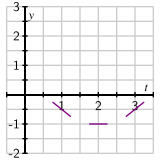
A grid for plotting small tangent lines connected to the given differential equation. The \(t\)-values range from \(-0.5\) to \(3.5\) and the \(y\)-values range from \(-2\) to \(3\text{.}\) The grid boxes are \(0.5 \times 0.5\)
Three small line segments of length about \(0.5\) are already plotted: one passing through \((1,-0.5)\) with slope \(m=-1\text{;}\) one passing through \((2,-1)\) with slope \(m=0\text{;}\) and one passing through \((3,-0.5)\) with slope \(m=1\text{.}\)
Also shown in the figure in (a) are the tangent lines to the solution \(y(t)\) at the points \(t=1, 2\text{,}\) and \(3\) (we will see how to find these later). Use the graph to measure the slope of each tangent line and verify that each agrees with the value specified by the differential equation.
Using the tangent lines from (a) and (b) as a guide, sketch a graph of the solution \(y(t)\) over the interval \(0\leq t\leq 3\) so that the lines are tangent to the graph of \(y(t)\text{.}\)
Preview Activity 7.2.1 shows that we can sketch the solution to an initial value problem if we know an appropriate collection of tangent lines. We can use the differential equation to find the slope of the tangent line at any point of interest, and hence generate and plot such a collection.
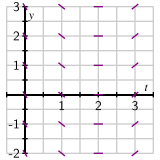
Let’s continue looking at the differential equation \(\frac{dy}{dt} = t-2\text{.}\) If \(t=0\text{,}\) this equation says that \(dy/dt = 0-2=-2\text{.}\) Note that this value holds regardless of the value of \(y\text{.}\) We will therefore sketch tangent lines for several values of \(y\) and \(t=0\) with a slope of \(-2\text{,}\) as shown in Figure 7.2.1. These tangent lines then provide a kind of road map for a solution to follow, starting from a certain initial condition.
A grid is provided for plotting small tangent lines connected to the given differential equation. The \(t\)-values range from \(-0.5\) to \(3.5\) and the \(y\)-values range from \(-2\) to \(3\text{.}\) The grid boxes are \(0.5 \times 0.5\)
In this first image, \(6\) small tangent lines are sketched at the points \((0,-2)\text{,}\)\((0,-1)\text{,}\)\(\ldots\text{,}\)\((0,3)\text{,}\) and each such line has slope \(m=-2\text{.}\)
In this second image, \(6\) small tangent lines are sketched at the points \((1,-2)\text{,}\)\((1,-1)\text{,}\)\(\ldots\text{,}\)\((1,3)\text{,}\) and each such line has slope \(m=-1\text{.}\)
Let’s continue in the same way: if \(t=1\text{,}\) the differential equation tells us that \(dy/dt = 1-2=-1\text{,}\) and this holds regardless of the value of \(y\text{.}\) We now sketch tangent lines for several values of \(y\) and \(t=1\) with a slope of \(-1\) in Figure 7.2.2.
Similarly, we see that when \(t=2\text{,}\)\(dy/dt = 0\) and when \(t=3\text{,}\)\(dy/dt=1\text{.}\) We may therefore add to our growing collection of tangent line plots to achieve Figure 7.2.3.
In this third image, \(12\) small tangent lines are sketched at the points corresponding to \(t=2\) and \(t=3\text{.}\) At the points \((2,-2)\text{,}\)\((2,-1)\text{,}\)\(\ldots\text{,}\)\((2,3)\text{,}\) each line has slope \(m=0\text{.}\) At the points \((3,-2)\text{,}\)\((3,-1)\text{,}\)\(\ldots\text{,}\)\((3,3)\text{,}\) each line has slope \(m=1\text{.}\)
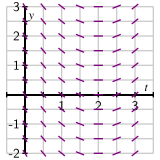
This image has a small tangent line at each point in the grid. For example, the tangent line at the point \((2.5,0.5)\) has slope \(0.5\text{.}\) The overall slope field indicates a pattern that suggests solution curves will be parabolas that open up and have their vertex at \(t = 2\text{.}\)
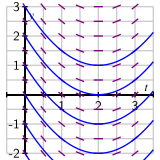
In Figure 7.2.3, we begin to see the solutions to the differential equation emerge. For the sake of even greater clarity, we add more tangent lines to provide the more complete picture shown at right in Figure 7.2.4.
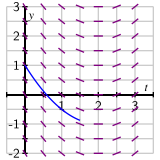
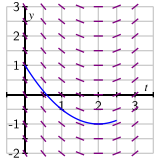
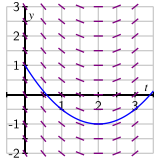
Figure 7.2.4 is called a slope field for the differential equation. It allows us to sketch solutions just as we did in the preview activity. We can begin with the initial value \(y(0) = 1\) and start sketching the solution by following the tangent line. Whenever the solution passes through a point at which a tangent line is drawn, that line is tangent to the solution. This principle leads us to the sequence of images in Figure 7.2.5.
Starting from the point \((0,1)\text{,}\) we follow the lines in the slope field, decreasing as \(t\) increases, but decreasing more slowly as we proceed. This first graph looks like a portion of a decreasing, concave up parabola that passes through the approximate points \((0,1)\text{,}\)\((0.5,0.1)\text{,}\)\((1,0.5)\text{,}\) and \((1.5,-0.9)\text{.}\)
Continuing from the preceding graph, we follow the lines in the slope field, creating more of a concave up parabola that has its vertex at approximately \((2,-1)\text{;}\) the parabola also passes through the approximate point \((2.5,-0.9)\text{.}\)
This image shows several solutions to \(\frac{dy}{dt} = t-2\) that correspond the initial values \(y(0)=-2\text{,}\)\(y(0)=-1\text{,}\)\(\ldots\text{,}\)\(y(0)=3\text{.}\) Each curve is a concave up parabola that has its vertex where \(t = 2\text{,}\) and each is a vertical shift of the others.
Just as we did for the equation \(\frac{dy}{dt} = t-2\text{,}\) we can construct a slope field for any differential equation of interest. The slope field provides us with visual information about how we expect solutions to the differential equation to behave.
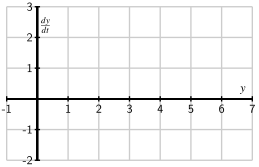
Make a plot of \(\frac{dy}{dt}\) versus \(y\) on the axes provided below. Looking at the graph, for what values of \(y\) does \(y\) increase and for what values of \(y\) does \(y\) decrease?
Axes and grid for plotting \(\frac{dy}{dt}\) as a function of \(y\text{.}\) The values of \(y\) range horizontally from \(-1\) to \(7\text{.}\) The values of \(\frac{dy}{dt}\) range vertically from \(-2\) to \(3\text{.}\)
Axes and grid for plotting the slope field. The values of \(t\) range horizontally from \(-1\) to \(7\text{.}\) The values of \(y\) range vertically from \(-1\) to \(7\text{.}\)
Verify that \(y(t) = 4 + 2e^{-t/2}\) is a solution to the given differential equation with the initial value \(y(0) = 6\text{.}\) Compare its graph to the one you sketched in (c).
Subsection7.2.3Equilibrium solutions and stability
As our work in Activity 7.2.2 demonstrates, first-order autonomous equations may have solutions that are constant. These are simple to detect by inspecting the differential equation \(dy/dt = f(y)\text{:}\) constant solutions necessarily have a zero derivative, so \(dy/dt = 0 = f(y)\text{.}\)
For example, in Activity 7.2.2, we considered the equation \(\frac{dy}{dt} = f(y)=-\frac12(y-4)\text{.}\) Constant solutions are found by setting \(f(y) = -\frac12(y-4) = 0\text{,}\) which we immediately see implies that \(y = 4\text{.}\)
Values of \(y\) for which \(f(y) = 0\) in an autonomous differential equation \(\frac{dy}{dt} = f(y)\) are called equilibrium solutions of the differential equation.
Make a plot of \(\frac{dy}{dt}\) versus \(y\) on the axes provided. Looking at the graph, for what values of \(y\) does \(y\) increase and for what values of \(y\) does \(y\) decrease?
Axes and grid for plotting \(\frac{dy}{dt}\) as a function of \(y\text{.}\) The values of \(y\) range horizontally from \(-1\) to \(7\text{.}\) The values of \(\frac{dy}{dt}\) range vertically from \(-2\) to \(3\text{.}\)
Axes and grid for plotting the slope field. The values of \(t\) range horizontally from \(-1\) to \(7\text{.}\) The values of \(y\) range vertically from \(-2\) to \(6\text{.}\)
On the slope field in (c), sketch the solutions to the given differential equation that correspond to initial values \(y(0)=-1, 0, 1, \ldots, 5\text{.}\)
An equilibrium solution \(\overline{y}\) is called stable if nearby solutions converge to \(\overline{y}\text{.}\) This means that if the initial condition varies slightly from \(\overline{y}\text{,}\) then \(\lim_{t\to\infty}y(t) = \overline{y}\text{.}\) Conversely, an equilibrium solution \(\overline{y}\) is called unstable if nearby solutions are pushed away from \(\overline{y}\text{.}\) Using your work above, classify the equilibrium solutions you found in (b) as either stable or unstable.
Suppose that \(y(t)\) describes the population of a species of living organisms and that the initial value \(y(0)\) is positive. What can you say about the eventual fate of this population?
Now consider a general autonomous differential equation of the form \(dy/dt = f(y)\text{.}\) Remember that an equilibrium solution \(\overline{y}\) satisfies \(f(\overline{y}) = 0\text{.}\) If we graph \(dy/dt = f(y)\) as a function of \(y\text{,}\) for which of the differential equations represented below is \(\overline{y}\) a stable equilibrium and for which is \(\overline{y}\) unstable? Why?
The graph of \(f(y)\) has a zero at \(y = \overline{y}\text{,}\) and \(f(y) \lt 0\) for \(y \lt \overline{y}\text{,}\) while \(f(y) \gt 0\) for \(y \gt \overline{y}\)
The graph of \(f(y)\) has a zero at \(y = \overline{y}\text{,}\) and \(f(y) \gt 0\) for \(y \lt \overline{y}\text{,}\) while \(f(y) \lt 0\) for \(y \gt \overline{y}\)
Autonomous differential equations sometimes have constant solutions that we call equilibrium solutions. These may be classified as stable or unstable, depending on the behavior of nearby solutions.
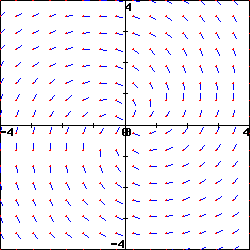
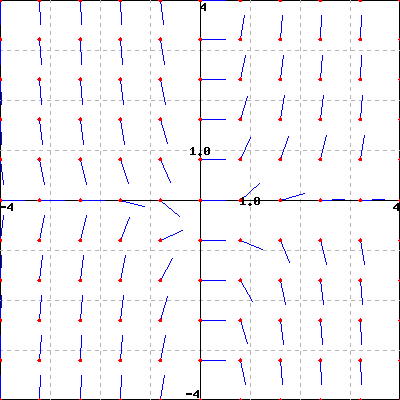
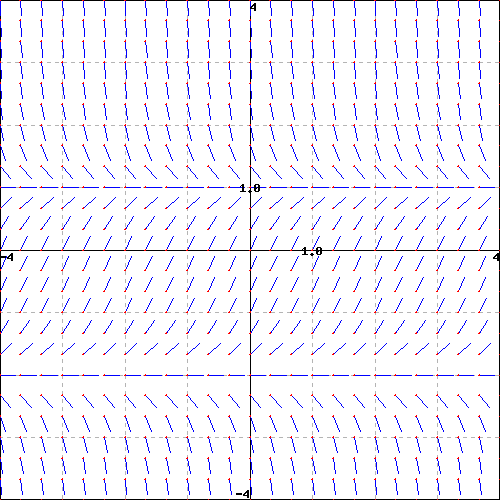
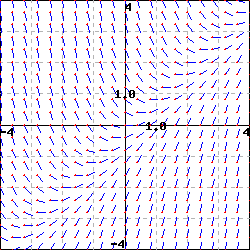
On a print-out of these slope fields, sketch for each three solution curves to the differential equations that generated them. Then complete the following statements:
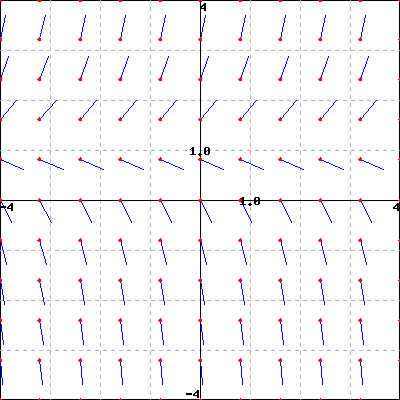
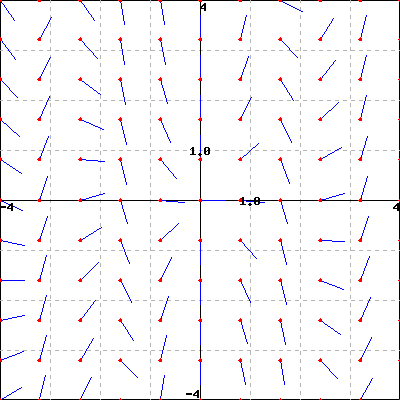
Match the following equations with their direction field. Clicking on each picture will give you an enlarged view. While you can probably solve this problem by guessing, it is useful to try to predict characteristics of the direction field and then match them to the picture.
Setting \(y'\) equal to a constant other than zero gives the curve of points where the slope is that constant. These are called isoclines, and can be used to construct the direction field picture by hand.
List the equilibrium solutions to this differential equation in increasing order and indicate whether or not these equilibria are stable, semi-stable, or unstable.
From your sketch, what is the equation of the solution to the differential equation that passes through (1,0)? (Verify that your solution is correct by substituting it into the differential equation.)
What do your sketches suggest is the solution whose initial value is \(y(0) = -1\text{?}\) Verify that this is indeed the solution to this initial value problem.
By considering the differential equation and the graphs you have sketched, what is the relationship between \(t\) and \(y\) at a point where a solution has a local minimum?
Consider the situation from Exercise 7.1.6.9 of Section 7.1: Suppose that the population of a particular species is described by the function \(P(t)\text{,}\) where \(P\) is expressed in millions. Suppose further that the population’s rate of change is governed by the differential equation
A plot of \(\frac{dP}{dt} = f(P)\) as a function of \(P\text{.}\) There is no vertical scale specified for \(\frac{dP}{dt}\text{;}\)\(P\) ranges horizontally from \(P=0\) to \(P=4\text{.}\) The graph of \(f(P)\) looks like a cubic polynomial with zeros at \(P=0\text{,}\)\(P=1\text{,}\) and \(P=3\text{.}\) The value of \(f(P)\) is negative for \(0 \lt P \lt 1\) and changes sign at each of its zeros.
Sketch a slope field for this differential equation. You do not have enough information to determine the actual slopes, but you should have enough information to determine where slopes are positive, negative, zero, large, or small, and hence determine the qualitative behavior of solutions.
Remember that we referred to this model for population growth as “growth with a threshold.” Explain why this characterization makes sense by considering solutions whose inital value is close to 1.
The population of a species of fish in a lake is \(P(t)\) where \(P\) is measured in thousands of fish and \(t\) is measured in months. The growth of the population is described by the differential equation
Sketch a graph of \(f(P) = P(6-P)\) and use it to determine the equilibrium solutions and whether they are stable or unstable. Write a complete sentence that describes the long-term behavior of the fish population.
Suppose now that the owners of the lake allow fishers to remove 1000 fish from the lake every month (remember that \(P(t)\) is measured in thousands of fish). Modify the differential equation to take this into account. Sketch the new graph of \(dP/dt\) versus \(P\text{.}\) Determine the new equilibrium solutions and decide whether they are stable or unstable.
What is the largest number of fish that can be removed per month without eliminating the fish population? If fish are removed at this maximum rate, what is the eventual population of fish?
Let \(y(t)\) be the number of thousands of mice that live on a farm; assume time \(t\) is measured in years. 1
This problem is based on an ecological analysis presented in a research paper by C.S. Hollings: The Components of Predation as Revealed by a Study of Small Mammal Predation of the European Pine Sawfly, Canadian Entomology91: 283-320.
The population of the mice grows at a yearly rate that is twenty times the number of mice. Express this as a differential equation.
Sketch a graph of the function \(M(y)\) for a single cat \(C=1\) and explain its features by looking, for instance, at the behavior of \(M(y)\) when \(y\) is small and when \(y\) is large.
Suppose that \(C=1\text{.}\) Find the equilibrium solutions and determine whether they are stable or unstable. Use this to explain the long-term behavior of the mice population depending on the initial population of the mice.
Suppose that \(C=60\text{.}\) Find the equilibrium solutions and determine whether they are stable or unstable. Use this to explain the long-term behavior of the mice population depending on the initial population of the mice.