Appendix B Answers to Activities
This appendix contains answers to all activities in the text. Answers for preview activities are not included.
1 Understanding the Derivative
1.1 How do we measure velocity?
1.1.2 Position and average velocity
1.1.3 Instantaneous Velocity
Activity 1.1.3.
1.1.3.a
1.1.3.b
1.1.3.c
1.1.3.d
Activity 1.1.4.
1.2 The notion of limit
1.2.2 The Notion of Limit
Activity 1.2.2.
1.2.2.a
1.2.2.b
1.2.2.c
1.2.3 Instantaneous Velocity
Activity 1.2.3.
1.2.3.a
1.2.3.b
1.2.3.c
Activity 1.2.4.
1.2.4.a
1.2.4.b
1.2.4.c
1.3 The derivative of a function at a point
1.3.2 The Derivative of a Function at a Point
Activity 1.3.2.
1.3.2.a
1.3.2.b
1.3.2.c
1.3.2.d
Activity 1.3.3.
1.3.3.a
1.3.3.b
1.3.3.c
1.3.3.d
Answer.
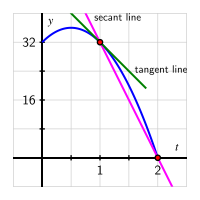
A plot of the quadratic function \(s(t) = -16t^2 + 16t + 32\text{,}\) the secant line through \((1,s(1))\) and \((2,s(2))\text{,}\) and the tangent line through \((1,s(1))\) with slope \(s'(1)=-16\)
The point \((1,32)\) is of most interest, and the curve, secant line, and tangent line all pass through this point. The function \(s(t)\) is a parabola that opens down with vertex \((\frac12,36)\) and a \(t\)-intercept at \((2,0)\text{.}\) The secant line passes through \((1,32)\) and \((2,0)\text{,}\) while the tangent line only passes through \((1,32)\text{.}\)
1.3.3.e
Activity 1.3.4.
1.3.4.a
Answer.
A plot of \(P(t) = 25000 e^{t/5}\) on the interval \(0 \lt t \lt 5\) (in decades). The values of \(P\) on the vertical axis range from \(0\) to \(100\) (in thousands). A secant line and a tangent line are also shown.
The function \(P(t) = 25000 e^{t/5}\) is exponential and increases as we move from left to right, beginning at the \(y\)-intercept \((0,25)\text{.}\) The points \((2,P(2))\) and \((4,P(4)\) are also shown, along with the secant line that joins those points and the tangent line to the curve at \((2,P(2))\text{.}\)
1.3.4.b
1.3.4.c
Answer.
1.3.4.d
1.3.4.e
1.3.4.f
1.4 The derivative function
1.4.2 How the derivative is itself a function
Activity 1.4.2.
Activity 1.4.3.
1.4.3.a
1.4.3.b
1.4.3.c
1.4.3.d
1.4.3.e
1.4.3.f
1.5 Interpreting, estimating, and using the derivative
1.5.2 Units of the derivative function
Activity 1.5.2.
1.5.2.a
Answer.
\(V'(10250) = -0.89\) means that the instantaneous rate of change of the car’s value when the car has been driven \(10250\) miles is \(-0.89\) dollars per mile. In addition, when the car has been driven \(10250\) miles, if the car is driven one more mile, we expect that the value of the car will decrease by about \(0.89\) dollars.
1.5.2.b
Answer.
\(W'(0.75) = 3.43\) means that the instantaneous rate of change of volume of water in the tank when the water is \(0.75\) meters deep is \(3.43\) liters per meter. This tells us that when the water is \(0.75\) meters deep, if the water rises one more meter, we expect that the volume of water in the tank will increase by about \(3.43\) liters.
1.5.2.c
Answer.
\(S'(20) = -0.527\) means that the instantaneous rate of change of the soda’s temperature at the instant \(t = 20\) minutes is \(-0.527\) degrees Celsius per minute. This tells us that after \(20\) minutes have elapsed, if one more minute passes, we expect that the soda’s temperature will drop by about \(0.527\) degrees Celsius.
1.5.2.d
Answer.
\(C'(19) = 52.1\) means that the instantaneous rate of change of the rate at which the biker is burning calories when traveling at a speed of \(19\) kilometers per hour is \(52.1\) calories per hour per kilometer per hour. This tells us that when the person is riding at \(19\) kilometers per hour, if they increase their speed by \(1\) kilometer per hour, we expect that they will burn about \(52.1\) additional calories over the next hour.
1.5.3 Toward more accurate derivative estimates
Activity 1.5.3.
1.5.3.a
1.5.3.b
1.5.3.c
1.5.3.d
1.5.3.e
Activity 1.5.4.
1.5.4.a
1.5.4.b
1.5.4.c
1.6 The second derivative
1.6.4 Concavity
Activity 1.6.2.
1.6.2.a
1.6.2.b
Answer.
Velocity is increasing on \(0\lt t\lt 1\text{,}\) \(3\lt t\lt 4\text{,}\) \(7\lt t\lt 8\text{,}\) and \(10\lt t\lt 11\text{;}\) \(y = v(t)\) is decreasing on \(1\lt t\lt 2\text{,}\) \(4\lt t\lt 5\text{,}\) \(8\lt t\lt 9\text{,}\) and \(11\lt t\lt 12\text{.}\) Velocity is constant on \(2\lt t\lt 3\text{,}\) \(5\lt t\lt 7\text{,}\) and \(9\lt t\lt 10\text{.}\)
1.6.2.c
1.6.2.d
1.6.2.e
Activity 1.6.3.
1.6.3.a
1.6.3.b
1.6.3.c
Answer.
At the moment \(t = 30\text{,}\) the temperature of the potato is \(167.6\) degrees; its temperature is rising at an instaneous rate of \(2.605\) degrees Fahrenheit per minute; and the rate at which the temperature is rising is falling at a rate of \(0.0516\) degrees Fahrenheit per minute per minute. Over the minute from \(t = 30\) to \(t = 31\text{,}\) we expect the temperature of the potato to rise about \(2.605\) degrees Fahrenheit and for the rate at which its temperature is increasing to drop by about \(0.0516\) degrees Fahrenheit per minute. We expect that \(F(31) \approx 169.7\) degrees Fahrenheit, and \(F'(31) \approx 2.01343\) degrees Fahrenheit per minute.
1.6.3.d
Activity 1.6.4.
1.7 Limits, continuity, and differentiability
1.7.2 Having a limit at a point
Activity 1.7.2.
1.7.2.a
1.7.2.b
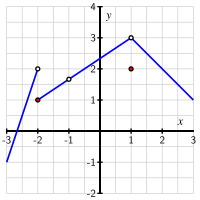
Answer.
\begin{equation*}
\lim_{x \to -2^-} f(x) = 2 \ \text{and} \lim_{x \to -2^+} f(x) = 1
\end{equation*}
\begin{equation*}
\lim_{x \to -1^-} f(x) = \frac{5}{3} \ \text{and} \lim_{x \to -1^+} f(x) = \frac{5}{3}
\end{equation*}
\begin{equation*}
\lim_{x \to 0^-} f(x) = \frac{7}{3} \ \text{and} \lim_{x \to 0^+} f(x) = \frac{7}{3}
\end{equation*}
\begin{equation*}
\lim_{x \to 1^-} f(x) = 3 \ \text{and} \lim_{x \to 1^+} f(x) = 3
\end{equation*}
\begin{equation*}
\lim_{x \to 2^-} f(x) = 2 \ \text{and} \lim_{x \to 2^+} f(x) = 2
\end{equation*}
1.7.2.c
1.7.2.d
1.7.2.e
1.7.3 Being continuous at a point
Activity 1.7.3.
1.7.3.a
1.7.3.b
1.7.3.c
1.7.3.d
1.7.3.e
1.7.4 Being differentiable at a point
Activity 1.7.4.
1.7.4.a
1.7.4.b
1.7.4.c
1.7.4.d
1.7.4.e
1.8 The tangent line approximation
1.8.3 The local linearization
Activity 1.8.2.
1.8.2.a
1.8.2.b
1.8.2.c
1.8.2.d
1.8.2.e
1.8.2.f
Activity 1.8.3.
1.8.3.a
1.8.3.b
1.8.3.c
Answer.
See the image in part 1.8.3.e.
1.8.3.d
1.8.3.e
1.8.3.f
Activity 1.8.4.
1.8.4.a
1.8.4.b
1.8.4.c
Answer.
| \(x\) | \(2.9\) | \(2.99\) | \(2.999\) | \(3\) | \(3.001\) | \(3.01\) | \(3.1\) |
| \(f(x)\) | \(1.051\) | \(1.00501\) | \(1.0005001\) | \(1\) | \(0.9995001\) | \(0.99501\) | \(0.951\) |
| \(g(x)\) | \(1.045\) | \(1.00495\) | \(1.0004995\) | \(1\) | \(0.9994995\) | \(0.99495\) | \(0.945\) |
| \(L(x)\) | \(1.05\) | \(1.005\) | \(1.0005\) | \(1\) | \(0.9995\) | \(0.995\) | \(0.95\) |
Near \(x = 3\text{,}\) \(L(x)\) always underestimates the value of \(f(x)\text{,}\) and \(L(x)\) always overestimates the value of \(g(x)\text{.}\)
1.8.4.d
2 Computing Derivatives
2.1 Elementary derivative rules
2.1.3 Constant, Power, and Exponential Functions
Activity 2.1.2.
2.1.2.a
2.1.2.b
2.1.2.c
2.1.2.d
2.1.2.e
2.1.2.f
2.1.2.g
2.1.4 Constant Multiples and Sums of Functions
Activity 2.1.3.
2.1.3.a
2.1.3.b
2.1.3.c
2.1.3.d
2.1.3.e
2.1.3.f
2.1.3.g
Activity 2.1.4.
2.1.4.a
2.1.4.b
2.1.4.c
2.1.4.d
2.2 The sine and cosine functions
2.2.2 The sine and cosine functions
Activity 2.2.2.
2.2.2.a
2.2.2.b
2.2.2.c
2.2.2.d
2.2.2.e
Activity 2.2.3.
2.2.3.a
2.2.3.b
2.2.3.c
2.2.3.d
2.2.3.e
Activity 2.2.4.
2.2.4.a
2.2.4.b
2.2.4.c
2.2.4.d
2.2.4.e
2.3 The product and quotient rules
2.3.2 The product rule
Activity 2.3.2.
2.3.2.a
2.3.2.b
2.3.2.c
2.3.2.d
2.3.3 The quotient rule
Activity 2.3.3.
2.3.3.a
2.3.3.b
2.3.3.c
2.3.3.d
2.3.4 Combining rules
Activity 2.3.4.
2.3.4.a
2.3.4.b
2.3.4.c
2.3.4.d
2.3.4.e
2.4 Derivatives of other trigonometric functions
2.4.2 Derivatives of the cotangent, secant, and cosecant functions
Activity 2.4.2.
2.4.2.a
2.4.2.b
2.4.2.c
2.4.2.d
Activity 2.4.3.
2.4.3.a
2.4.3.b
2.4.3.c
2.4.3.d
Activity 2.4.4.
2.4.4.a
2.4.4.b
2.4.4.c
2.4.4.d
2.4.4.e
2.5 The chain rule
2.5.2 The chain rule
Activity 2.5.2.
2.5.2.a
2.5.2.b
2.5.2.c
2.5.2.d
2.5.2.e
2.5.3 Using multiple rules simultaneously
Activity 2.5.3.
2.5.3.a
2.5.3.b
2.5.3.c
2.5.3.d
2.5.3.e
Activity 2.5.4.
2.5.4.a
2.5.4.b
2.5.4.c
2.5.4.d
2.6 Derivatives of inverse functions
2.6.3 The derivative of the natural logarithm function
Activity 2.6.2.
2.6.2.a
2.6.2.b
2.6.2.c
2.6.2.d
2.6.2.e
2.6.4 Inverse trigonometric functions and their derivatives
Activity 2.6.3.
2.6.3.a
2.6.3.b
2.6.3.c
2.6.3.d
2.6.3.e
2.6.3.f
Activity 2.6.4.
2.6.4.a
2.6.4.b
2.6.4.c
2.6.4.d
2.6.4.e
2.6.4.f
2.7 Derivatives of functions given implicitly
2.7.2 Implicit Differentiation
Activity 2.7.2.
2.7.2.a
2.7.2.b
2.7.2.c
2.7.2.d
Activity 2.7.3.
2.7.3.a
2.7.3.b
2.7.3.c
Activity 2.7.4.
2.7.4.a
2.7.4.b
2.7.4.c
3 Using Derivatives
3.1 Related rates
3.1.2 Related Rates Problems
Activity 3.1.2.
3.1.2.a
3.1.2.b
3.1.2.c
3.1.2.d
3.1.2.e
3.1.2.f
Activity 3.1.3.
3.1.3.a
3.1.3.b
3.1.3.c
3.1.3.d
3.1.3.e
Activity 3.1.4.
3.1.4.a
3.1.4.b
3.1.4.c
3.1.4.d
3.1.4.e
3.1.4.f
Activity 3.1.5.
Answer.
Let \(x\) denote the position of the ball at time \(t\) and \(z\) the distance from the ball to first base, as pictured below.
ADD ALT TEXT TO THIS IMAGE
\(\left. \frac{dz}{dt} \right|_{x = 45} = \frac{100}{\sqrt{5}} \approx 44.7214 \ \text{feet/sec} \text{.}\)
Let \(r\) be the runner’s position at time \(t\) and let \(s\) be the distance between the runner and the ball, as pictured.
ADD ALT TEXT TO THIS IMAGE
\(\left. \frac{ds}{dt} \right|_{x = 45} = \frac{430}{\sqrt{17}} \approx 104.2903 \ \text{feet/sec} \text{.}\)
3.2 Using derivatives to evaluate limits
3.2.2 Using derivatives to evaluate indeterminate limits of the form \(\frac{0}{0}\text{.}\)
Activity 3.2.2.
3.2.2.a
3.2.2.b
3.2.2.c
3.2.2.d
Activity 3.2.3.
3.2.3.a
3.2.3.b
3.2.3.c
3.2.3 Limits involving \(\infty\)
Activity 3.2.4.
3.2.4.a
3.2.4.b
3.2.4.c
3.2.4.d
3.2.4.e
3.3 Using derivatives to identify extreme values
3.3.2 Critical numbers and the first derivative test
Activity 3.3.2.
3.3.2.a
3.3.2.b
3.3.2.c
3.3.2.d
3.3.3 The second derivative test
Activity 3.3.3.
3.3.3.a
3.3.3.b
3.3.3.c
3.3.3.d
Activity 3.3.4.
3.3.4.a
3.3.4.b
Answer.
If \(\frac{2}{k^2} \gt 1\text{,}\) then the equation \(\cos(kx) = \frac{2}{k^2}\) has no solution. Hence, whenever \(k^2 \lt 2\text{,}\) or \(k \lt \sqrt{2} \approx 1.414\text{,}\) it follows that the equation \(\cos(kx) = \frac{2}{k^2}\) has no solutions \(x\text{,}\) which means that \(h''(x)\) is never zero (indeed, for these \(k\)-values, \(h''(x)\) is always positive so that \(h\) is always concave up). On the other hand, if \(k \ge \sqrt{2}\text{,}\) then \(\frac{2}{k^2} \le 1\text{,}\) which guarantees that \(\cos(kx) = \frac{2}{k^2}\) has infinitely many solutions, due to the periodicity of the cosine function. At each such point, \(h''(x) = 2 - k^2 \cos(kx)\) changes sign, and therefore \(h\) has infinitely many inflection points whenever \(k \ge \sqrt{2}\text{.}\)
3.3.4.c
Answer.
To see why \(h\) can only have a finite number of critical numbers regardless of the value of \(k\text{,}\) consider the equation
\begin{equation*}
0 = h'(x) = 2x - k\sin(kx)\text{,}
\end{equation*}
which implies that \(2x = k\sin(kx)\text{.}\) Since \(-1 \le \sin(kx) \le 1\text{,}\) we know that \(-k \le k\sin(kx) \le k\text{.}\) Once \(|x|\) is sufficiently large, we are guaranteed that \(|2x| \gt k\text{,}\) which means that for large \(x\text{,}\) \(2x\) and \(k\sin(kx)\) cannot intersect. Moreover, for relatively small values of \(x\text{,}\) the functions \(2x\) and \(k\sin(kx)\) can only intersect finitely many times since \(k\sin(kx)\) oscillates a finite number of times. This is why \(h\) can only have a finite number of critical numbers, regardless of the value of \(k\text{.}\)
3.4 Using derivatives to describe families of functions
3.4.2 Describing families of functions in terms of parameters
Activity 3.4.2.
3.4.2.a
3.4.2.b
3.4.2.c
3.4.2.d
Activity 3.4.3.
3.4.3.a
3.4.3.b
3.4.3.c
3.4.3.d
3.4.3.e
Activity 3.4.4.
3.4.4.a
3.4.4.b
3.4.4.c
3.4.4.d
3.4.4.e
3.5 Global optimization
3.5.2 Global Optimization
Activity 3.5.2.
3.5.2.a
3.5.2.b
3.5.2.c
3.5.2.d
3.5.2.e
Activity 3.5.3.
3.5.3.a
3.5.3.b
3.5.3.c
3.5.3.d
3.5.3.e
3.5.3.f
3.5.3 Moving toward applications
Activity 3.5.4.
3.5.4.a
3.5.4.b
3.5.4.c
3.5.4.d
3.5.4.e
3.5.4.f
3.6 Applied optimization
3.6.2 More applied optimization problems
Activity 3.6.2.
3.6.2.a
3.6.2.b
3.6.2.c
3.6.2.d
Activity 3.6.3.
Activity 3.6.4.
Activity 3.6.5.
4 The Definite Integral
4.1 Determining distance traveled from velocity
4.1.2 Area under the graph of the velocity function
Activity 4.1.2.
4.1.2.a
4.1.2.b
4.1.2.c
4.1.2.d
4.1.3 Two approaches: area and antidifferentiation
Activity 4.1.3.
4.1.3.a
4.1.3.b
4.1.3.c
4.1.3.d
4.1.3.e
4.1.3.f
4.1.4 When velocity is negative
Activity 4.1.4.
4.1.4.a
4.1.4.b
4.1.4.c
4.1.4.d
4.2 Riemann sums
4.2.2 Sigma Notation
Activity 4.2.2.
4.2.2.a
4.2.2.b
4.2.2.c
4.2.2.d
4.2.2.e
4.2.3 Riemann Sums
Activity 4.2.3.
4.2.3.a
4.2.3.b
4.2.3.c
4.2.3.d
4.2.4 When the function is sometimes negative
Activity 4.2.4.
4.2.4.a
4.2.4.b
4.2.4.c
4.2.4.d
4.3 The definite integral
4.3.2 The definition of the definite integral
Activity 4.3.2.
4.3.2.a
4.3.2.b
4.3.2.c
4.3.2.d
4.3.3 Some properties of the definite integral
Activity 4.3.3.
4.3.3.a
4.3.3.b
4.3.3.c
4.3.3.d
4.3.3.e
4.3.4 How the definite integral is connected to a function’s average value
Activity 4.3.4.
4.3.4.a
4.3.4.b
4.3.4.c
4.3.4.d
4.3.4.e
4.3.4.f
4.4 The Fundamental Theorem of Calculus
4.4.2 The Fundamental Theorem of Calculus
Activity 4.4.2.
4.4.2.a
4.4.2.b
4.4.2.c
4.4.2.d
4.4.2.e
4.4.3 Basic antiderivatives
Activity 4.4.3.
4.4.3.a
Answer.
| given function, \(f(x)\) | antiderivative, \(F(x)\) |
| \(k\text{,}\) (\(k \ne 0\)) | \(kx\) |
| \(x^n\text{,}\) \(n \ne -1\) | \(\frac{1}{n+1}x^{n+1}\) |
| \(\frac{1}{x}\text{,}\) \(x \gt 0\) | \(\ln(x)\) |
| \(\sin(x)\) | \(-\cos(x)\) |
| \(\cos(x)\) | \(\sin(x)\) |
| \(\sec(x) \tan(x)\) | \(\sec(x)\) |
| \(\csc(x) \cot(x)\) | \(-\csc(x)\) |
| \(\sec^2 (x)\) | \(\tan(x)\) |
| \(\csc^2 (x)\) | \(-\cot(x)\) |
| \(e^x\) | \(e^x\) |
| \(a^x\) \((a \gt 1)\) | \(\frac{1}{\ln(a)} a^x\) |
| \(\frac{1}{1+x^2}\) | \(\arctan(x)\) |
| \(\frac{1}{\sqrt{1-x^2}}\) | \(\arcsin(x)\) |
\(\int_0^1 \left(x^3 - x - e^x + 2\right) \,dx = \frac{11}{4} - e\text{.}\)
4.4.3.b
4.4.3.c
4.4.4 The total change theorem
Activity 4.4.4.
4.4.4.a
4.4.4.b
4.4.4.c
4.4.4.d
5 Evaluating Integrals
5.1 Constructing accurate graphs of antiderivatives
5.1.2 Constructing the graph of an antiderivative
Activity 5.1.2.
5.1.2.a
5.1.2.b
5.1.2.c
5.1.2.d
Answer.
\(F(1) = -\frac{1}{2}\text{;}\) \(F(2) = \frac{\pi}{4} - \frac{1}{2}\text{;}\) \(F(3) = \frac{\pi}{4} - 1\text{;}\) \(F(4) = \frac{\pi}{4}-2\text{;}\) \(F(5) = \frac{\pi}{4} - \frac{5}{2}\text{;}\) \(F(6) = \frac{\pi}{2} - \frac{5}{2}\text{;}\) \(F(7) = \frac{3\pi}{4} - \frac{5}{2}\text{;}\) \(F(8) = \frac{3\pi}{4} - \frac{5}{2}\text{;}\) and \(F(-1) = -1\text{.}\)
5.1.2.e
5.1.2.f
5.1.3 Multiple antiderivatives of a single function
Activity 5.1.3.
5.1.3.a
Answer.
The first, \(G(x)\text{,}\) looks like two quadratic functions joined together at \(x = 0\text{:}\) one that’s concave down on the left, and another that’s concave up on the right. Three important points on the graph of \(G(x)\) are \(G(-1) = 0\text{,}\) \(G(0) = -\frac12\text{,}\) and \(G(1) = -1\text{.}\)
The other two antiderivatives, \(H(x)\) and \(F(x)\text{,}\) are vertical shifts of \(G(x)\text{.}\) \(H(x)\) satisfies \(H(-2)=0\) and \(F(x)\) satisfies \(F(-2)=2\text{.}\)
5.1.3.b
5.1.3.c
Answer.
On the intervals \([-1,0]\) and \([2,3]\text{,}\) \(P(x)=0\text{.}\) On the interval \((0,1)\text{,}\) \(P(x)\) is increasing and concave up. There’s a corner point on the graph of \(P(x)\) at the point \((1,4/3)\text{,}\) and there \(P(x)\) changes to become decreasing and concave up on the interval \((1,2)\text{.}\)
5.1.4 Functions defined by integrals
Activity 5.1.4.
5.1.4.a
5.1.4.b
5.1.4.c
5.1.4.d
5.1.4.e
5.1.4.f
5.2 The Second Fundamental Theorem of Calculus
5.2.2 The Second Fundamental Theorem of Calculus
Activity 5.2.2.
5.2.2.a
5.2.2.b
5.2.2.c
5.2.2.d
5.2.2.e
5.2.3 Understanding Integral Functions
Activity 5.2.3.
5.2.3.a
5.2.3.b
5.2.3.c
5.2.3.d
Answer.
| \(x\) | \(-10\) | \(-5\) | \(0\) | \(5\) | \(10\) |
|---|---|---|---|---|---|
| \(F(x)\) | 2.35973 | 1.64038 | 0 | 1.64038 | 2.35973 |
5.2.3.e
Answer.
A plot of \(y = F(x)\text{.}\) The \(x\) values on the coordinate axes range horizontally from \(-10.5\) to \(-10.5\text{,}\) and the \(y\) values range vertically from \(-5.5\) to \(-5.5\text{.}\) The function \(F\) is decreasing for \(x \lt 0\) and increasing for \(x \gt 0\) with a global minimum at \(x = 0\text{.}\) The function \(F\) is concave up for approximately \(-1 \lt x \lt 1\) and concave down otherwise.
5.2.3.f
5.2.4 Differentiating an Integral Function
Activity 5.2.4.
5.2.4.a
5.2.4.b
5.2.4.c
5.2.4.d
5.2.4.e
5.3 Integration by substitution
5.3.2 Reversing the Chain Rule: First Steps
Activity 5.3.2.
5.3.2.a
5.3.2.b
5.3.2.c
5.3.2.d
5.3.2.e
5.3.2.f
5.3.3 Reversing the Chain Rule: \(u\)-substitution
Activity 5.3.3.
5.3.3.a
5.3.3.b
5.3.3.c
5.3.4 Evaluating Definite Integrals via \(u\)-substitution
Activity 5.3.4.
5.3.4.a
5.3.4.b
5.3.4.c
5.4 Integration by parts
5.4.2 Reversing the Product Rule: Integration by Parts
Activity 5.4.2.
5.4.2.a
5.4.2.b
5.4.2.c
5.4.2.d
5.4.3 Some Subtleties with Integration by Parts
Activity 5.4.3.
5.4.3.a
5.4.3.b
5.4.3.c
5.4.3.d
5.4.3.e
5.4.4 Using Integration by Parts Multiple Times
Activity 5.4.4.
5.4.4.a
5.4.4.b
5.4.4.c
5.4.4.d
5.4.4.e
5.5 Other options for finding algebraic antiderivatives
5.5.2 The Method of Partial Fractions
Activity 5.5.2.
5.5.2.a
5.5.2.b
5.5.2.c
5.5.3 Using an Integral Table
Activity 5.5.3.
5.5.3.a
5.5.3.b
5.5.3.c
5.5.3.d
5.6 Numerical integration
5.6.2 The Trapezoid Rule
Activity 5.6.2.
5.6.2.a
5.6.2.b
5.6.2.c
5.6.2.d
5.6.2.e
5.6.4 Simpson’s Rule
Activity 5.6.3.
5.6.3.a
5.6.3.b
5.6.3.c
5.6.3.d
5.6.3.e
5.6.3.f
5.6.5 Overall observations regarding \(L_n\text{,}\) \(R_n\text{,}\) \(T_n\text{,}\) \(M_n\text{,}\) and \(S_{2n}\text{.}\)
Activity 5.6.4.
5.6.4.a
5.6.4.b
5.6.4.c
5.6.4.d
5.6.4.e
6 Using Definite Integrals
6.1 Using definite integrals to find area and length
6.1.2 The Area Between Two Curves
Activity 6.1.2.
6.1.2.a
6.1.2.b
6.1.2.c
6.1.2.d
Answer.
The left-hand region has area
\begin{equation*}
A_1 = \int_{\frac{1 - \sqrt{5}}{2}}^0 \left( \left(x^3 - x \right) - x^2\right) dx = \dfrac{13 - 5\sqrt{5}}{24} \approx 0.075819\text{.}
\end{equation*}
The right-hand region has area
\begin{equation*}
A_2 = \int_0^{\frac{1 + \sqrt{5}}{2}} \left( x^2 - \left(x^3 - x \right) \right) dx = \dfrac{13 + 5\sqrt{5}}{24} \approx 1.007514 \text{.}
\end{equation*}
The total area is \(A_1 + A_2 \approx 1.083333\text{.}\)
6.1.3 Finding Area with Horizontal Slices
Activity 6.1.3.
6.1.3.a
6.1.3.b
6.1.3.c
6.1.3.d
6.1.4 Finding the length of a curve
Activity 6.1.4.
6.1.4.a
6.1.4.b
6.1.4.c
6.1.4.d
6.1.4.e
6.2 Using definite integrals to find volume
6.2.2 The Volume of a Solid of Revolution
Activity 6.2.2.
6.2.2.a
6.2.2.b
6.2.2.c
6.2.2.d
6.2.2.e
6.2.3 Revolving about the \(y\)-axis
Activity 6.2.3.
6.2.3.a
6.2.3.b
6.2.3.c
6.2.3.d
6.2.3.e
6.2.4 Revolving about horizontal and vertical lines other than the coordinate axes
Activity 6.2.4.
6.2.4.a
6.2.4.b
6.2.4.c
6.2.4.d
6.3 Density, mass, and center of mass
6.3.2 Density
Activity 6.3.2.
6.3.2.a
6.3.2.b
Answer.
-
\(V = \int_{0}^{5} \pi (4 - \frac{4}{5}x)^2 \, dx = \frac{80\pi}{3} \approx 83.7758 \mbox{m}^3\text{.}\)
-
\(M = \frac{64000\pi}{3} \approx 67020.6433 \mbox{kg} \text{.}\)
-
\(\displaystyle M = \int_{0}^{5} (400 + \frac{200}{1+x^2}) \cdot \pi (4-\frac{4}{5}x)^2 \, dx = 128 \pi (\frac{265}{3} + 24 \arctan(5) - 5 \ln(26)) \approx 42224.8024 \mbox{kg}\)
6.3.2.c
6.3.3 Weighted Averages
Activity 6.3.3.
6.3.3.a
6.3.3.b
6.3.3.c
6.3.3.d
6.3.3.e
6.3.3.f
6.3.3.g
6.3.3.h
Answer.
If we have an existing arrangement and balancing point, moving one of the locations to the left will move the balancing point to the left; similarly, moving one of the locations to the right will move the balancing point to the right. If instead we add weight to an existing location, if that location is left of the balancing point, the balancing point will move left; the behavior is similar if on the right.
6.3.4 Center of Mass
Activity 6.3.4.
6.3.4.a
6.3.4.b
6.3.4.c
6.3.4.d
6.3.4.e
6.3.4.f
6.4 Physics applications: work, force, and pressure
6.4.2 Work
Activity 6.4.2.
6.4.2.a
6.4.2.b
6.4.2.c
6.4.2.d
6.4.3 Work: Pumping Liquid from a Tank
Activity 6.4.3.
6.4.3.a
6.4.3.b
6.4.3.c
6.4.4 Force due to Hydrostatic Pressure
Activity 6.4.4.
6.4.4.a
6.4.4.b
6.4.4.c
6.5 Improper integrals
6.5.2 Improper Integrals Involving Unbounded Intervals
Activity 6.5.2.
6.5.2.a
Answer.
6.5.2.b
Answer.
-
\(\int_1^{10} \frac{1}{x^{3/2}} dx = 2 - \frac{2}{\sqrt{10}}\) \(\int_1^{1000} \frac{1}{x^{3/2}} dx = 2 - \frac{2}{\sqrt{1000}}\) \(\int_1^{100000} \frac{1}{x^{3/2}} dx = 2 - \frac{2}{\sqrt{100000}}\)
-
\(\int_1^b \frac{1}{x^{3/2}} dx = 2 - \frac{2}{\sqrt{b}}\text{.}\)
-
\(\displaystyle \lim_{b \to \infty} \int_1^b \frac{1}{x^{3/2}} dx = \lim_{b \to \infty} \left( 2 - \frac{2}{\sqrt{b}} \right) = 2\)
6.5.2.c
6.5.2.d
6.5.3 Convergence and Divergence
Activity 6.5.3.
6.5.3.a
6.5.3.b
6.5.3.c
6.5.3.d
6.5.3.e
6.5.3.f
6.5.4 Improper Integrals Involving Unbounded Integrands
Activity 6.5.4.
6.5.4.a
6.5.4.b
6.5.4.c
6.5.4.d
6.5.4.e
6.5.4.f
7 Differential Equations
7.1 An introduction to differential equations
7.1.2 What is a differential equation?
Activity 7.1.2.
7.1.2.a
7.1.2.b
7.1.2.c
7.1.2.d
7.1.2.e
7.1.3 Differential equations in the world around us
Activity 7.1.3.
7.1.3.a
7.1.3.b
Answer.
For the meteorite:
\begin{align*}
\left. \frac{dv}{dt}\right|_{(v = 3.5)} \amp = -0.25 \amp \left. \frac{dv}{dt}\right|_{(v = 4)} \amp = -0.5\\
\left. \frac{dv}{dt}\right|_{(v = 4.5)} \amp = -0.75 \amp \left. \frac{dv}{dt}\right|_{(v = 5.5)} \amp \approx -1.25
\end{align*}
A graph of the points from parts (a) and (b) is shown in the following diagram:
A plot of points of the form \((v, \frac{dv}{dt})\) on the grid provided in part (a), using the data generated from the graphs in parts (a) and (b). The data points appear to lie on a line that passes through the point \((3,0)\) and has slope \(m = -0.5\text{.}\)
7.1.3.c
7.1.3.d
7.1.3.e
7.1.3.f
7.1.3.g
7.1.4 Solving a differential equation
Activity 7.1.4.
7.1.4.a
7.1.4.b
7.1.4.c
7.1.4.d
7.2 Qualitative behavior of solutions to differential equations
7.2.2 Slope fields
Activity 7.2.2.
7.2.2.a
Answer.
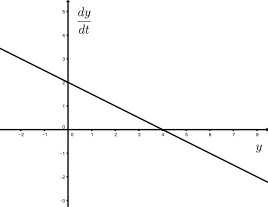
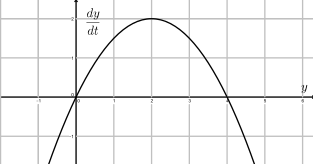
When \(y \lt 4\text{,}\) \(y\) is an increasing function of \(t\text{.}\) When \(y \gt 4\text{,}\) \(y\) is a decreasing function of \(t\text{.}\)
Plot of \(\frac{dy}{dt}\) as a function of \(y\text{.}\) The graph is a straight line with slope \(m=-\frac{1}{2}\) that passes through the point \((4,0)\text{.}\)
7.2.2.b
Answer.
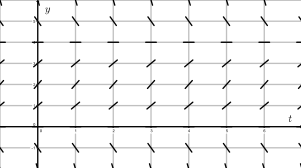
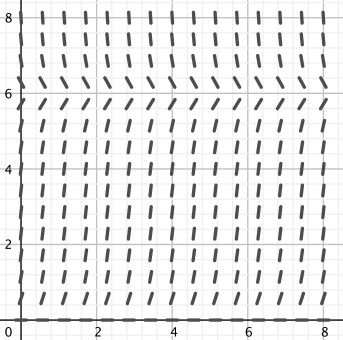
The slope field shows a constant solution of \(y = 4\) and that solutions that satisfy \(y(0) \gt 4\) are decreasing while solutions that satisfy \(y(0) \lt 4\) are increasing
. For a fixed value of \(y\text{,}\) the line segments in the slope field all have the same slope, regardless of \(t\text{.}\) When \(y=4\text{,}\) the slopes are all \(0\text{.}\) When \(y \gt 4\text{,}\) the slopes are all negative, and the larger the value of \(y\) the more negative the slope is. When \(y \lt 4\text{,}\) the slopes are all positive, and the smaller the value of \(y\) the more positive the slope is.
7.2.2.c
Answer.
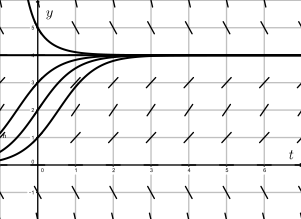
The graph shows the plots of four different solutions to the differential equation with the graphs superimposed on the slope field.
The solution that satisfies \(y(0) = 6\) is a decreasing, concave up function that approaches \(y = 4\) as \(t\) increases without bound. The solution that satisfies \(y(0) = 4\) is constant (that is, a horizontal line). The solutions that satisfy \(y(0) = 0\) and \(y(0) = 2\) are increasing, concave down functions that approach \(y = 4\) as \(t\) increases without bound.
7.2.2.d
7.2.2.e
7.2.3 Equilibrium solutions and stability
Activity 7.2.3.
7.2.3.a
Answer.
When \(y \lt 0\) and when \(y \gt 4\text{,}\) \(y\) is a decreasing function of \(t\text{.}\) When \(0 \lt y \lt 4\text{,}\) \(y\) is a increasing function of \(t\text{.}\)
Plot of \(\frac{dy}{dt}\) as a function of \(y\text{.}\) The graph is a concave down parabola that has zeros at \(y = 0\) and \(y=4\) with a maximum at the point \((2,2)\text{.}\)
7.2.3.b
7.2.3.c
Answer.
The slope field shows constant solutions of \(y = 0\) and \(y = 4\text{.}\) Solutions that satisfy \(y(0) \gt 4\) or \(y(0) \lt 0\) are decreasing, while solutions that satisfy \(0 \lt y(0) \lt 4\) are increasing
. For a fixed value of \(y\text{,}\) the line segments in the slope field all have the same slope, regardless of \(t\text{.}\) When \(y \gt 4\text{,}\) the slopes are all negative, and the larger the value of \(y\) the more negative the slope is. When \(y=4\text{,}\) the slopes are all \(0\text{.}\) When \(0 \lt y \lt 4\text{,}\) the slopes are all positive, and the closer \(y\) is to \(0\) or \(4\) the closer the slope is to \(0\text{;}\) the largest positive slope occurs when \(y=2\text{.}\) Finally, when \(y \lt 0\text{,}\) the slopes are all negative, and the more negative the value of \(y\) the more negative the slope is.
7.2.3.d
Answer.
The graph shows the plots of the different solutions to the differential equation with the graphs superimposed on the slope field.
The solution that satisfies \(y(0) = 5\) is a decreasing, concave up function that approaches \(y = 4\) as \(t\) increases without bound. The solution that satisfies \(y(0) = 4\) is constant (that is, a horizontal line). The solutions that satisfy \(y(0) = 1\text{,}\) \(y(0) = 2\text{,}\) and \(y(0) = 3\) are increasing functions that approach \(y = 4\) as \(t\) increases without bound. Each of these three functions is concave down for all values of \(y\) such that \(y \gt 2\text{.}\) The solution that satisfies \(y(0) = 0\) is constant (that is, a horizontal line). Finally, the solution that satisfies \(y(0) = -1\)is a decreasing concave down function that decreases without bound.
7.2.3.e
7.2.3.f
7.2.3.g
7.3 Euler’s method
7.3.2 Euler’s Method
Activity 7.3.2.
7.3.2.a
Answer.
| \(t_i\) | \(y_i\) | \(dy/dt\) | \(\Delta y\) |
| \(0\) | \(0\) | \(-1\) | \(-0.2\) |
| \(0.2\) | \(-0.2\) | \(-0.6\) | \(-0.12\) |
| \(0.4\) | \(-0.32\) | \(-0.2\) | \(-0.04\) |
| \(0.6\) | \(-0.36\) | \(0.2\) | \(0.04\) |
| \(0.8\) | \(-0.32\) | \(0.6\) | \(0.12\) |
| \(1.0\) | \(-0.2\) | \(1\) | \(0.2\) |
This image is a plot of the \(5\) points that result from applying Euler’s method to the given differential equation and the initial condition.
After the initial point \((0,0)\text{,}\) the plotted points are \((0.2,-0.2)\text{,}\) \((0.4,-0.32)\text{,}\) \((0.6,-0.36)\text{,}\) \((0.8,-0.32)\text{,}\) \((1,-0.2)\text{.}\)
7.3.2.b
7.3.2.c
7.3.2.d
Answer.
If we first think about how \(y_1\) is generated for the initial value problem \(\frac{dy}{dt} = f(t) = 2t-1, \ y(0) = 0\text{,}\) we see that \(y_1 = y_0 + \Delta t \cdot f(t_0)\text{.}\) Since \(y_0 = 0\text{,}\) we have \(y_1 = \Delta t \cdot f(t_0)\text{.}\) From there, we know that \(y_2\) is given by \(y_2 = y_1 + \Delta t f(t_1)\text{.}\) Substituting our earlier result for \(y_1\text{,}\) we see that \(y_2 = \Delta t \cdot f(t_0) + \Delta t f(t_1)\text{.}\) Continuing this process up to \(y_5\text{,}\) we get
\begin{equation*}
y_5 = \Delta t \cdot f(t_0) + \Delta t f(t_1) + \Delta t f(t_2) + \Delta t f(t_3) + \Delta t f(t_4)
\end{equation*}
This is precisely the left Riemann sum with five subintervals for the definite integral \(\int_0^1 (2t-1)~dt\text{.}\)
Activity 7.3.3.
7.3.3.a
Answer.
The slope field shows constant solutions of \(y = 0\) and \(y = 6\text{.}\) Solutions that satisfy \(y(0) \gt 6\) are decreasing, while solutions that satisfy \(0 \lt y(0) \lt 6\) are increasing
. For a fixed value of \(y\text{,}\) the line segments in the slope field all have the same slope, regardless of \(t\text{.}\) When \(y \gt 6\text{,}\) the slopes are all negative, and the larger the value of \(y\) the more negative the slope is. When \(y=6\text{,}\) the slopes are all \(0\text{.}\) When \(0 \lt y \lt 6\text{,}\) the slopes are all positive, and the closer \(y\) is to \(0\) or \(6\) the closer the slope is to \(0\text{;}\) the largest positive slope occurs when \(y=3\text{.}\) Finally, when \(y = 0\text{,}\) the slopes are all zero.
7.3.3.b
7.3.3.c
7.3.3.d
Answer.
| \(t_i\) | \(y_i\) | \(dy/dt\) | \(\Delta y\) |
| \(0.0\) | \(1.0000\) | \(5.0000\) | \(1.0000\) |
| \(0.2\) | \(2.0000\) | \(8.0000\) | \(1.6000\) |
| \(0.4\) | \(3.6000\) | \(8.6400\) | \(1.7280\) |
| \(0.6\) | \(5.3280\) | \(3.5804\) | \(0.7161\) |
| \(0.8\) | \(6.0441\) | \(-0.2664\) | \(-0.0533\) |
| \(1.0\) | \(5.9908\) | \(0.0551\) | \(0.0110\) |
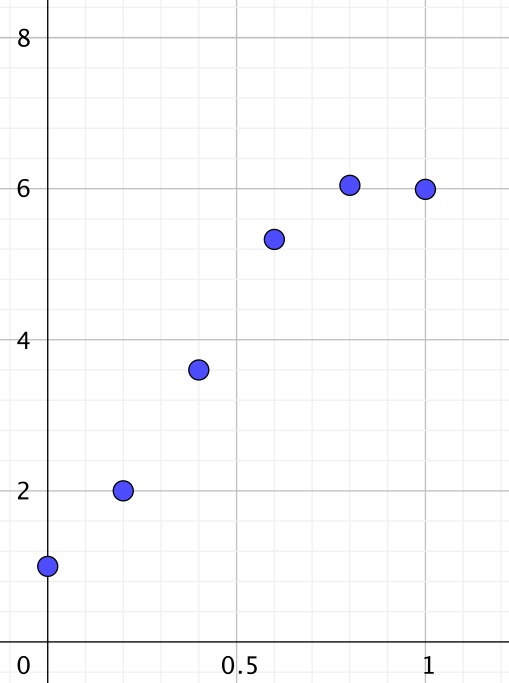
This image is a plot of the \(5\) points that result from applying Euler’s method to the given differential equation and the initial condition.
After the initial point \((0,1)\text{,}\) the plotted points are \((0.2,2)\text{,}\) \((0.4,3.6)\text{,}\) \((0.6,5.328)\text{,}\) \((0.8,6.0441)\text{,}\) \((1,5.9908)\text{.}\)
7.3.3.e
7.4 Separable differential equations
7.4.2 Solving separable differential equations
Activity 7.4.2.
7.4.2.a
7.4.2.b
7.4.2.c
7.4.2.d
7.4.2.e
Activity 7.4.3.
7.4.3.a
7.4.3.b
7.4.3.c
7.4.3.d
7.4.3.e
Activity 7.4.4.
7.4.4.a
7.4.4.b
7.4.4.c
7.4.4.d
7.4.4.e
7.5 Modeling with differential equations
7.5.2 Developing a differential equation
Activity 7.5.2.
7.5.2.a
7.5.2.b
7.5.2.c
7.5.2.d
7.5.2.e
7.5.2.f
Activity 7.5.3.
7.5.3.a
7.5.3.b
7.5.3.c
7.5.3.d
7.5.3.e
7.5.3.f
7.6 Population growth and the logistic equation
7.6.2 The earth’s population
Activity 7.6.2.
7.6.2.a
7.6.2.b
7.6.2.c
7.6.2.d
7.6.2.e
7.6.2.f
7.6.2.g
7.6.3 Solving the logistic differential equation
Activity 7.6.3.
7.6.3.a
7.6.3.b
7.6.3.c
7.6.3.d
7.6.3.e
8 Taylor Polynomials and Taylor Series
8.1 Extending local linearization
8.1.2 Finding a quadratic approximation
Activity 8.1.2.
8.1.2.a
8.1.2.b
8.1.2.c
Answer.
| \(f(x)=\) | \(e^x\) | \(T_2(x)=\) | \(b_0 + b_1 x + b_2 x^2\) |
| \(f'(x)=\) | \(e^x\) | \(T_2'(x)=\) | \(b_1 + 2b_2 x\) |
| \(f''(x)=\) | \(e^x\) | \(T_2''(x)=\) | \(2b_2\) |
| \(f(0)=\) | \(1\) | \(T_2(0)=\) | \(b_0\) |
| \(f'(0)=\) | \(1\) | \(T_2'(0)=\) | \(b_1\) |
| \(f''(0)=\) | \(1\) | \(T_2''(0)=\) | \(2b_2\) |
8.1.2.d
8.1.2.e
8.1.2.f
8.1.3 Over and over again
Activity 8.1.3.
8.1.3.a
Answer.
| \(f(x)=\) | \(e^x\) | \(T_3(x)=\) | \(c_0 + c_1 x + c_2 x^2 + c_3 x^3\) |
| \(f'(x)=\) | \(e^x\) | \(T_3'(x)=\) | \(c_1 + 2 c_2 x + 3 c_3 x^2\) |
| \(f''(x)=\) | \(e^x\) | \(T_3''(x)=\) | \(2 c_2 + 3 \cdot 2 c_3 x\) |
| \(f'''(x)=\) | \(e^x\) | \(T_3'''(x)=\) | \(3 \cdot 2 c_3\) |
| \(f(0)=\) | \(1\) | \(T_3(0)=\) | \(c_0\) |
| \(f'(0)=\) | \(1\) | \(T_3'(0)=\) | \(c_1\) |
| \(f''(0)=\) | \(1\) | \(T_3''(0)=\) | \(2c_2\) |
| \(f'''(0)=\) | \(1\) | \(T_3'''(0)=\) | \(6c_3\) |
8.1.3.b
8.1.3.c
8.1.3.d
8.1.4 As the degree of the approximation increases
Activity 8.1.4.
8.1.4.a
Answer.
The first seven columns and eleven rows of the spreadsheet are:
| \(\Delta x\) | \(x\) | \(f(x)\) | \(T_1(x)\) | \(T_2(x)\) | \(T_3(x)\) | \(T_4(x)\) |
| \(0.1\) | \(-1.0\) | \(0.36787\) | \(0.00000\) | \(0.50000\) | \(0.33333\) | \(0.37500\) |
| \(0.1\) | \(-0.9\) | \(0.40657\) | \(0.10000\) | \(0.50500\) | \(0.38350\) | \(0.41083\) |
| \(0.1\) | \(-0.8\) | \(0.44933\) | \(0.20000\) | \(0.52000\) | \(0.43467\) | \(0.45173\) |
| \(0.1\) | \(-0.7\) | \(0.49659\) | \(0.30000\) | \(0.54500\) | \(0.48783\) | \(0.49784\) |
| \(0.1\) | \(-0.6\) | \(0.54881\) | \(0.40000\) | \(0.58000\) | \(0.54400\) | \(0.54940\) |
| \(0.1\) | \(-0.5\) | \(0.60653\) | \(0.50000\) | \(0.62500\) | \(0.60417\) | \(0.60677\) |
| \(0.1\) | \(-0.4\) | \(0.67032\) | \(0.60000\) | \(0.68000\) | \(0.66933\) | \(0.67040\) |
| \(0.1\) | \(-0.3\) | \(0.74082 \) | \(0.70000 \) | \(0.74500 \) | \(0.74050 \) | \(0.74084\) |
| \(0.1\) | \(-0.2\) | \(0.81873 \) | \(0.80000 \) | \(0.82000 \) | \(0.81867 \) | \(0.81873\) |
| \(0.1\) | \(-0.1\) | \(0.90484 \) | \(0.90000 \) | \(0.90500 \) | \(0.90483 \) | \(0.90484\) |
| \(0.1\) | \(0.0\) | \(1.00000\) | \(1.00000\) | \(1.00000\) | \(1.00000\) | \(1.00000\) |
The next four columns and four rows of the spreadsheet are:
| \(|f(x)-T_1(x)|\) | \(|f(x)-T_2(x)|\) | \(|f(x)-T_3(x)|\) | \(|f(x)-T_4(x)|\) |
| \(0.36787\) | \(0.13212\) | \(0.03454\) | \(0.00712\) |
| \(0.30657\) | \(0.09843\) | \(0.02307\) | \(0.00426\) |
| \(0.24933 \) | \(0.07067 \) | \(0.01466 \) | \(0.00240\) |
| \(0.19659 \) | \(0.04841 \) | \(0.00875 \) | \(0.00125\) |
8.1.4.b
8.1.4.c
8.1.4.d
8.1.4.e
8.1.4.f
8.2 Taylor polynomials
8.2.2 Taylor polynomials
Activity 8.2.2.
8.2.2.a
Answer.
| \(f(x) =\) | \(\cos(x)\) | \(f(0) =\) | \(\cos(0) = 1\) |
| \(f'(x) = \) | \(-\sin(x)\) | \(f'(0) = \) | \(0\) |
| \(f''(x) = \) | \(-\cos(x)\) | \(f''(0) = \) | \(-1\) |
| \(f'''(x) = \) | \(\sin(x)\) | \(f'''(0) = \) | \(0\) |
| \(f^{(4)}(x) = \) | \(\cos(x)\) | \(f^{(4)}(0) = \) | \(1\) |
| \(f^{(5)}(x) = \) | \(-\sin(x)\) | \(f^{(5)}(0) = \) | \(0\) |
| \(f^{(6)}(x) = \) | \(-\cos(x)\) | \(f^{(6)}(0) = \) | \(-1\) |
| \(f^{(7)}(x) = \) | \(\sin(x)\) | \(f^{(7)}(0) = \) | \(0\) |
| \(f^{(8)}(x) = \) | \(\cos(x)\) | \(f^{(8)}(0) = \) | \(1\) |
8.2.2.b
Answer.
\begin{align*}
T_2(x) \amp= 1 + 0x - \frac{1}{2!}x^2 \\
T_4(x) \amp= 1 + 0x - \frac{1}{2!}x^2 + 0x^3 + \frac{1}{4!}x^4 \\
T_6(x) \amp= 1 + 0x - \frac{1}{2!}x^2 + 0x^3 + \frac{1}{4!}x^4 + 0x^5 - \frac{1}{6!}x^6\\
T_8(x) \amp= 1 + 0x - \frac{1}{2!}x^2 + 0x^3 + \frac{1}{4!}x^4 + 0x^5 - \frac{1}{6!}x^6 + 0x^7 + \frac{1}{8!}x^8
\end{align*}
8.2.2.c
8.2.2.d
Answer.
The function \(f(x)=\cos(x)\) graphed together with its degree \(2\text{,}\) \(4\text{,}\) and \(6\) Taylor polynomial approximations near the point \((0,f(0))\text{.}\)
The graph shows that the function and the three Taylor approximations all intersect at the point \((0,f(0))\text{,}\) have the same slope at that point, and look like they have the same curvature at that point.
The four functions are very close together on the interval \((-1,1)\text{,}\) but outside of that interval there start to be visual differences as the parabola continues to open downward, but the function \(\cos(x)\) oscillates and the degree \(4\) and \(6\) approximations follow the function for longer.
The degree \(4\) Taylor polynomial approximation looks very close to the function \(\cos(x)\) on the interval \((-1.75,1.75)\text{,}\) and the degree \(6\) Taylor polynomial approximation looks very close to the function \(\cos(x)\) on the interval \((-2.5,2.5)\text{.}\)
As the degree of the approximation increases, the accuracy of the approximation improves at each fixed \(x\)-value and in how large the interval is on which the approximation is accurate.
8.2.2.e
Answer.
| \(\Delta x\) | \(x\) | \(f(x)\) | \(T_2(x)\) | \(T_4(x)\) | \(T_6(x)\) |
| \(0.2\) | \(-2.0\) | \(-0.41615\) | \(-1.00000\) | \(-0.33333\) | \(-0.42222\) |
| \(0.2\) | \(-1.8\) | \(-0.22720\) | \(-0.62000\) | \(-0.18260\) | \(-0.22984\) |
| \(0.2\) | \(-1.6\) | \(-0.02920\) | \(-0.28000\) | \(-0.00693\) | \(-0.03024\) |
| \(\cdots\) | \(\cdots\) | \(\cdots\) | \(\cdots\) | \(\cdots\) | \(\cdots\) |
| \(0.2\) | \(1.6\) | \(-0.02920\) | \(-0.28000\) | \(-0.00693\) | \(-0.03024\) |
| \(0.2\) | \(1.8\) | \(-0.22720\) | \(-0.62000\) | \(-0.18260\) | \(-0.22984\) |
| \(0.2\) | \(2.0\) | \(-0.41615\) | \(-1.00000\) | \(-0.33333\) | \(-0.42222\) |
| \(|f(x)-T_2(x)|\) | \(|f(x)-T_4(x)|\) | \(|f(x)-T_6(x)|\) |
| \(0.58385\) | \(0.08281\) | \(0.00608\) |
| \(0.39280\) | \(0.04460\) | \(0.00263\) |
| \(0.25080\) | \(0.02227\) | \(0.00104\) |
| \(\cdots\) | \(\cdots\) | \(\cdots\) |
| \(0.25080\) | \(0.02227\) | \(0.00104\) |
| \(0.39280\) | \(0.04460\) | \(0.00263\) |
| \(0.58385\) | \(0.08281\) | \(0.00608\) |
\(|f(x) - T_2(x)| \lt 0.1\) for roughly \(-1.2 \lt x \lt 1.2\text{;}\) \(|f(x) - T_4(x)| \lt 0.1\) for \(-2 \lt x \lt 2\text{;}\) \(|f(x) - T_6(x)| \lt 0.1\) for approximately \(-2.8 \lt x \lt 2.8\text{.}\)
8.2.3 Taylor polynomial approximations centered at an arbitrary value \(a\)
Activity 8.2.3.
8.2.3.a
Answer.
| \(f(x) =\) | \(\ln(x)\) | \(f(1) =\) | \(0\) |
| \(f'(x) = \) | \(x^{-1}\) | \(f'(1) = \) | \(1\) |
| \(f''(x) = \) | \(-1 \cdot x^{-2}\) | \(f''(1) = \) | \(-1\) |
| \(f'''(x) = \) | \((-2)(-1)x^{-3}\) | \(f'''(1) = \) | \((-2)(-1)\) |
| \(f^{(4)}(x) = \) | \((-3)(-2)(-1)x^{-4}\) | \(f^{(4)}(1) = \) | \((-3)(-2)(-1)\) |
8.2.3.b
8.2.3.c
Answer.
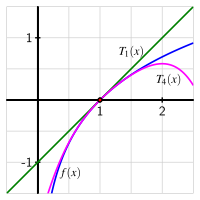
The function \(f(x)=\ln(x)\) graphed together with its degree \(1\) and \(4\) Taylor polynomial approximations near the point \((1,f(1))\text{.}\)
The graph shows that the function and the two Taylor approximations all intersect at the point \((1,f(1))\) and have the same slope at that point.
The three functions are very close together on the interval \((0.5,1.5)\text{,}\) but outside of that interval there start to be visual differences as the tangent line continues straight, but the function \(\ln(x)\) is curved, and the degree \(4\) approximation stays close to the function for longer.
The degree \(4\) Taylor polynomial approximation looks very close to the function \(\ln(x)\) on the interval \((0.3,1.75)\text{.}\)
8.2.3.d
8.2.3.e
Answer.
\(T_5(x) = 1 (x-1) - \frac{1}{2} (x-1)^2 + \frac{1}{3}(x-1)^3 - \frac{1}{4}(x-1)^4 + \frac{1}{5}(x-1)^5\text{;}\) \(T_6(x) = 1 (x-1) - \frac{1}{2} (x-1)^2 + \frac{1}{3}(x-1)^3 - \frac{1}{4}(x-1)^4 + \frac{1}{5}(x-1)^5 - \frac{1}{6}(x-1)^6\text{.}\)
\(|f(x) - T_5(x)| \lt 0.1\) for about \(0.24 \lt x \lt 1.999\text{;}\) \(|f(x) - T_6(x)| \lt 0.1\) for about \(0.21 \lt x \lt 2\text{.}\) While the interval of accuracy gets wider as the degree increases, it seems not to extend past \(x = 2\) and doesn’t move much to the left.
Activity 8.2.4.
8.2.4.a
Answer.
| \(f(x) =\) | \(\ln(x)\) | \(f(2) =\) | \(\ln(2)\) |
| \(f'(x) = \) | \(x^{-1}\) | \(f'(2) = \) | \(\frac{1}{2}\) |
| \(f''(x) = \) | \(-1 \cdot x^{-2}\) | \(f''(2) = \) | \(-\frac{1}{2^2}\) |
| \(f'''(x) = \) | \((-2)(-1)x^{-3}\) | \(f'''(2) = \) | \(\frac{(-2)(-1)}{2^3}\) |
| \(f^{(4)}(x) = \) | \((-3)(-2)(-1)x^{-4}\) | \(f^{(4)}(2) = \) | \(\frac{(-3)(-2)(-1)}{2^4}\) |
8.2.4.b
8.2.4.c
Answer.
The function \(f(x)=\ln(x)\) graphed together with its degree \(1\) and \(4\) Taylor polynomial approximations near the point \((2,f(2))\text{.}\)
The graph shows that the function and the two Taylor approximations all intersect at the point \((2,f(2))\) and have the same slope at that point.
The three functions are very close together on the interval \((1.5,2.5)\text{,}\) but outside of that interval there start to be visual differences as the tangent line continues straight, but the function \(\ln(x)\) is curved, and the degree \(4\) approximation stays close to the function for longer.
The degree \(4\) Taylor polynomial approximation looks very close to the function \(\ln(x)\) on the interval \((0.7,3.5)\text{.}\)
\(T_4(x)\) provides a much better approximation of \(f(x)\) near \(a = 2\) and on a wider interval.
8.2.4.d
8.2.4.e
Answer.
\(T_5(x) = \ln(2) + \frac{1}{2}(x-2) - \frac{1}{2 \cdot 2^2} (x-2)^2 + \frac{1}{3 \cdot 2^3}(x-2)^3 - \frac{1}{4 \cdot 2^4}(x-2)^4 + \frac{1}{5 \cdot 2^5} (x-2)^5
\text{;}\) \(T_6(x) = \ln(2) + \frac{1}{2}(x-2) - \frac{1}{2 \cdot 2^2} (x-2)^2 + \frac{1}{3 \cdot 2^3}(x-2)^3 - \frac{1}{4 \cdot 2^4}(x-2)^4 + \frac{1}{5 \cdot 2^5} (x-2)^5 - \frac{1}{6 \cdot 2^6} (x-2)^6
\text{.}\)
\(|f(x) - T_5(x)| \lt 0.1\) for roughly \(0.48 \lt x \lt 4\text{;}\) \(|f(x) - T_6(x)| \lt 0.1\) for about \(0.42 \lt x lt 4\text{.}\) By moving to \(a = 2\text{,}\) which is further away from the asymptote at \(x = 0\text{,}\) we can get approximations of \(ln(x)\) that seem to be good all the way up to \(x = 4\text{.}\)
8.3 Geometric sums
8.3.2 Finite Geometric Series
Activity 8.3.2.
8.3.2.a
8.3.2.b
8.3.2.c
8.3.2.d
8.3.3 Infinite Geometric Series
Activity 8.3.3.
8.3.3.a
Answer.
\(S_5 = \frac{a - ar^5}{1-r} = \frac{1 - (1/3)^5}{1-(1/3)} = \frac{121}{81} \approx 1.4938
\text{;}\) \(S_{10} = \frac{a - ar^{10}}{1-r} = \frac{1 - (1/3)^{10}}{1-(1/3)} = \frac{29524}{19683} \approx 1.49997
\text{;}\) \(S = \frac{a}{1-r} = \frac{1}{1-\frac{1}{3}} = \frac{1}{\frac{2}{3}} = \frac{3}{2}
\text{.}\)
8.3.3.b
Answer.
\(S_5 = \frac{a - ar^5}{1-r} = \frac{4 - 4\cdot(-1/2)^5}{1-(-1/2)} = \frac{11}{4}
\text{;}\) \(S_{10} = \frac{a - ar^{10}}{1-r} = \frac{4 - 4\cdot(-1/2)^{10}}{1-(-1/2)} = \frac{341}{128} = 2.6640625
\text{;}\) \(S = \frac{a}{1-r} = \frac{4}{1+\frac{1}{2}} = \frac{4}{\frac{3}{2}} = \frac{8}{3}
\text{.}\)
8.3.3.c
8.3.3.d
Answer.
8.3.3.e
Answer.
\(S_5 = \frac{a - ar^5}{1-r} = \frac{\frac{4}{3} - \frac{4}{3} \cdot (-2/3)^5}{1-(-2/3)} = \frac{220}{243} \approx 0.905
\text{;}\) \(S_{10} = \frac{a - ar^{10}}{1-r} = \frac{\frac{4}{3} - \frac{4}{3} \cdot (-2/3)^{10}}{1-(-2/3)} = \frac{46420}{59049} \approx 0.786
\text{;}\) \(S = \frac{a}{1-r} = \frac{\frac{4}{3}}{1+\frac{2}{3}} = \frac{4}{5} = 0.8
\text{.}\)
8.3.4 How geometric series naturally connect to Taylor polynomials
Activity 8.3.4.
8.3.4.a
Answer.
| \(f(x) =\) | \(\frac{1}{1-x} = (1-x)^{-1}\) |
| \(f'(x) =\) | \((-1)(1-x)^{-2}(-1)\) |
| \(f''(x) = \) | \((-2)(-1)(1-x)^{-3}(-1)(-1)\) |
| \(f'''(x) = \) | \((-3)(-2)(-1)(1-x)^{-4}(-1)(-1)(-1)\) |
| \(f^{(4)}(x) = \) | \((-4)(-3)(-2)(-1)(1-x)^{-5}(-1)(-1)(-1)(-1)\) |
| \(f^{(5)}(x) = \) | \((-5)(-4)(-3)(-2)(-1)(1-x)^{-6}(-1)(-1)(-1)(-1)(-1)\) |
8.3.4.b
Answer.
| \(f(0) =\) | \(\frac{1}{1-0} = 1\) | \(c_0 =\) | \(f(0) = 1\) |
| \(f'(0) =\) | \((-1)(1-0)^{-2}(-1) = 1\) | \(c_1 =\) | \(\frac{f'(0)}{1!} = \frac{1}{1!} = 1\) |
| \(f''(0) = \) | \((-2)(-1)(1)^{-3}(-1)(-1) = 2!\) | \(c_2 =\) | \(\frac{f''(0)}{2!} = \frac{2!}{2!} = 1 \) |
| \(f'''(0) = \) | \((-3)(-2)(-1)(1)^{-4}(-1)(-1)(-1) = 3!\) | \(c_3 = \) | \(\frac{f'''(0)}{3!} = \frac{3!}{3!} = 1 \) |
| \(f^{(4)}(0) = \) | \((-4)(-3)(-2)(-1)(1)^{-5}(-1)(-1)(-1)(-1) = 4!\) | \(c_4 =\) | \(\frac{f^{(4)}(0)}{4!} = \frac{4!}{4!} = 1 \) |
| \(f^{(5)}(0) = \) | \((-5)(-4)(-3)(-2)(-1)(1)^{-6}(-1)(-1)(-1)(-1)(-1) = 5!\) | \(c_5 =\) | \(\frac{f^{(5)}(0)}{5!} = \frac{5!}{5!} = 1 \) |
8.3.4.c
8.3.4.d
8.3.4.e
8.4 Taylor series
8.4.2 Taylor series and the Ratio Test
Activity 8.4.2.
8.4.2.a
8.4.2.b
8.4.2.c
8.4.2.d
8.4.3 Taylor series of several important functions
Activity 8.4.3.
8.4.3.a
8.4.3.b
8.4.3.c
8.4.3.d
8.4.3.e
8.5 Finding and using Taylor series
8.5.2 Using substitution and algebra to find new Taylor series expressions
Activity 8.5.2.
8.5.2.a
8.5.2.b
8.5.2.c
8.5.2.d
8.5.2.e
8.5.3 Differentiating and integrating Taylor series
Activity 8.5.3.
8.5.3.a
8.5.3.a.i
8.5.3.a.ii
8.5.3.a.iii
8.5.3.a.iv
8.5.3.b
8.5.3.b.i
8.5.3.b.ii
8.5.3.b.iii
8.5.3.b.iv
Activity 8.5.4.
8.5.4.a
8.5.4.b
8.5.4.c
8.5.4.d
8.5.4.e
8.6 Quantifying the accuracy of approximations
8.6.2 Alternating series of real numbers
Activity 8.6.2.
8.6.2.a
8.6.2.b
Answer.
\(\int_0^1 e^{-x^2} \, dx \approx 1 - \frac{1}{3} + \frac{1}{2! \cdot 5} - \frac{1}{3! \cdot 7} + \frac{1}{4! \cdot 9} - \frac{1}{5! \cdot 11} + \frac{1}{6! \cdot 13} = \frac{1614779}{2162160} = 0.7468360343\ldots\) and this approximation has error at most \(\frac{1}{7! \cdot 15} = \frac{1}{756600} \approx 0.0000132\)
8.6.2.c
8.6.2.d
Answer.
The alternating series
\begin{equation*}
1 - \frac{1}{2} \cdot 1^2 + \frac{1}{3} \cdot 1^3 - \cdots + (-1)^{n-1} \frac{1}{n} \cdot 1^n + \cdots
\end{equation*}
converges by the Alternating Series Theorem, and its exact sum is \(\ln(2)\text{.}\)
Using the Alternating Series Estimation Theorem to approximate within \(0.01\) results in
\begin{equation*}
\ln(2) \approx 1 - \frac{1}{2} + \frac{1}{3} - \cdots + \frac{1}{99} = 0.69817217931 \ldots\text{.}
\end{equation*}
8.6.3 Error Approximations for Taylor Polynomials
Activity 8.6.3.
8.6.3.a
8.6.3.b
Answer.
Using \(M = 1\) as the bound on the \((n+1)^{\text{st}}\) derivative of \(\cos(x)\text{,}\) the Lagrange error bound tells us that we need to use \(n = 11\) (\(n+1 = 12\)) to achieve the desired accuracy, and that \(\cos(1) \approx T_{10}(1) = 1 - \frac{1^2}{2!} + \frac{1^4}{4!} - \cdots - \frac{1^{10}}{10!} \approx 0.54030230379189\text{.}\)