Skip to main content
Contents Index Dark Mode Prev Up Next \(
\newcommand{\lt}{<}
\newcommand{\gt}{>}
\newcommand{\amp}{&}
\definecolor{fillinmathshade}{gray}{0.9}
\newcommand{\fillinmath}[1]{\mathchoice{\colorbox{fillinmathshade}{$\displaystyle \phantom{\,#1\,}$}}{\colorbox{fillinmathshade}{$\textstyle \phantom{\,#1\,}$}}{\colorbox{fillinmathshade}{$\scriptstyle \phantom{\,#1\,}$}}{\colorbox{fillinmathshade}{$\scriptscriptstyle\phantom{\,#1\,}$}}}
\)
Preview Activity 1.1.1 .
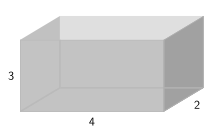
Suppose that a rectangular aquarium is being filled with water. The tank is
\(4\) feet long by
\(2\) feet wide by
\(3\) feet high, and the hose that is filling the tank is delivering water at a rate of
\(0.5\) cubic feet per minute.
Figure 1.1.1. The empty aquarium. The aquarium, partially filled.
Figure 1.1.2. The aquarium, partially filled.
(a) What are some different quantities that are changing in this scenario?
(b) After
\(1\) minute has elapsed, how much water is in the tank? At this moment, how deep is the water?
(c) How much water is in the tank and how deep is the water after
\(2\) minutes? After
\(3\) minutes?
(d) How long will it take for the tank to be completely full? Why?