Section 13.10 Parameterizations of Surfaces and Surface Area

Subsection 13.10.1 Introduction

In SectionΒ 9.6 and ChapterΒ 10, we used parameterizations of curves as a means to use the many tools of single-variable calculus to analyze the curve. One of the central goals of this section is to extend the idea of parameterizations to surfaces in an attempt to apply the many multivariable tools of ChapterΒ 11 and ChapterΒ 12. In the preview activity, we look at how geometric knowledge of right circular cylinders and cones allows us to create a vector-valued function that describes the points on the surface of a cone.

Preview Activity 13.10.1.

Recall the standard parameterization of the unit circle given by
\begin{equation*} x(t) = \cos(t) \qquad\text{ and }\qquad y(t) = \sin(t)\text{,} \end{equation*}
where \(0 \le t \le 2\pi\text{.}\)

(a)

Find a parameterization of a circle of radius of 2 in \(\R^3\) centered at \((0,0,1)\) and lying in the plane \(z=1\text{.}\) Be sure to give the bounds on the parameter as well.
Hint.
The \(z\)-coordinate is constant, so only \(x\) and \(y\) will change in the parameterization.

(b)

Find a parameterization of a circle of radius of 2 in \(\R^3\) centered at \((0,0,-5)\) and lying in the plane \(z=-5\text{.}\) Be sure to give the bounds on the parameter as well.

(c)

Find a parameterization of a circle of radius of 2 in \(\R^3\) centered at \((0,0,a)\) and lying in the plane \(z=a\text{.}\) Be sure to give the bounds on the parameter as well.

(d)

A right circular cylinder surface centered on the \(z\)-axis, such as the one shown in FigureΒ 13.10.1, can be thought of as being built from a stack of circles of fixed radius centered at points along the \(z\)-axis. Find a parameterization of a right circular cylinder surface of radius 2, centered on the \(z\)-axis with heights from \(b\) to \(c\text{.}\) In other words, express the \(x\)-, \(y\)-, and \(z\)-coordinates of points on the right circular cylinder in terms of two variables. Use the parameter \(s\) to measure the height of the circle above or below the \(xy\)-plane and use the parameter \(t\) to measure the location around the circle centered on the \(z\)-axis. Use the previous part to write out each of the following:
\begin{equation*} x(s,t) = \fillinmath{XXX}\qquad y(s,t) = \fillinmath{XXX} \qquad z(s,t)= \fillinmath{XXX} \end{equation*}
with the bounds on \(s\) and \(t\) given by
\begin{equation*} \fillinmath{X} \leq s \leq \fillinmath{X} \text{ and } \fillinmath{X} \leq t \leq \fillinmath{X} \end{equation*}
Figure 13.10.1. A right circular cylinder centered on the \(z\)-axis

(e)

Just as a right circular cylinder can be viewed as a β€œstack” of circles of fixed radius, a cone can be viewed as a stack of circles with varying radius. In particular, the cone \(z^2=x^2+y^2\) has contours that are circles centered on the \(z\)-axis with radius changing according to the rule \(r=z\text{.}\) Find a parameterization of the cone \(z^2=x^2+y^2\) with heights from \(b\) to \(c\text{.}\) In other words, we want to express the \(x\text{,}\) \(y\text{,}\) and \(z\) coordinates of points on the cone in terms of two variables. We will let the parameter \(s\) measure the height of the circle (in our stack) above or below the \(xy\)-plane and let the parameter \(t\) measure the location around the circle centered on the \(z\)-axis. Write out each of the following:
\begin{equation*} x(s,t) = \hspace{1.0in} y(s,t) = \hspace{1.0in} z(s,t)= \end{equation*}
with the bounds on \(s\) and \(t\) given by
\begin{equation*} \hspace{1.0in} \leq s \leq \hspace{1.0in} \text{ and } \hspace{1.0in} \leq t \leq \hspace{1.0in} \end{equation*}

Subsection 13.10.2 Parameterizations of Surfaces

Preview ActivityΒ 13.10.1 concluded with a description of a cone in terms of measurements corresponding to the angle around the \(z\)-axis and the position relative to the \(xy\)-plane. Geometric intuition described the coordinate relationships of the two surfaces in Preview ActivityΒ 13.10.1. This subsection discusses how to use algebraic and geometric tools to find parameterizations of curved surfaces. The next subsection describes some important geometric measurements of a surface that can be done using a parameterization. The section concludes by examining how parameterizations can be used to compute the surface area of a surface in three dimensions.
In a single-variable setting, any function may have its graph expressed parametrically. For instance, the graph of \(y = g(x)\) can be parameterized as \(\langle t, g(t) \rangle\text{,}\) where \(t\) belongs to the domain of \(g\text{.}\) Certain curves that are not expressible with \(y\) as a function of \(x\) can also be represented parametrically. For instance, the unit circle cannot be represented with either the \(x\)- or \(y\)-coordinate written as a function of the other. However, it can be parameterized as \(\langle \cos(t), \sin(t) \rangle\text{,}\) where \(0 \leq t \lt 2\pi\text{.}\)
A surface of the form \(z = f(x,y)\) can be expressed parametrically by
\begin{equation*} \langle x(s,t), y(s,t), z(s,t) \rangle = \langle s, t, f(s,t) \rangle, \end{equation*}
where \((s,t)\) varies over the entire domain of \(f\text{.}\) In the parameterization above, we can think of \(s\) as acting like \(x\) and \(t\) as acting like \(y\text{.}\) Therefore, any familiar surface expressed as \(z=f(x,y)\) can be written as a parametric surface. The greater power of parameterizations is realized when dealing with surfaces such as a sphere that cannot be expressed by a single function \(z = f(x,y)\) but can be represented parametrically.
For surfaces such as ellipsoids or hyperboloids where one coordinate cannot be expressed as a function of the other two, a good strategy is to use geometric knowledge of these surfaces to express each of the \(x\)-, \(y\)-, and \(z\)-coordinates in terms of two measurements/parameters. In Preview ActivityΒ 13.10.1, the parameters measured the rotational coordinate around the \(z\)-axis and the height above or below the \(xy\)-plane (along with the radial coordinate in the cone). In the next example, we will look at how to parameterize a torus using this same strategy.

Example 13.10.2.

In this example, we want to parameterize the torus shown in FigureΒ 13.10.3.
A three-dimensional plot with axes labeled \(x\text{,}\) \(y\text{,}\) and \(z\text{.}\) A surface similar to the outside of a bagel is shown. The center of the hole in the surface is at the origin and its inner opening is oriented along the \(z\)-axis. Circular slices oriented radially from the \(z\)-axis are highlighted in green and circular slices centered around the \(z\)-axis are highlighted in red.
Figure 13.10.3. The surface of a torus shown centered at the origin with hole oriented around the \(z\)-axis
To describe each point on the torus in terms of two parameters, we can think of the torus as being generated by rotating a circle or radius \(a\) around the \(z\)-axis. Looking at a radial slice from the \(z\)-axis out, as shown by the gray plane in FigureΒ 13.10.4, we generate the torus by revolving the points on the green circle around the \(z\)-axis, as shown by the red circles. This means that we can describe each point on the torus in terms of its location along the green circle and its location along a red circle, representing rotation around the \(z\)-axis.
A three-dimensional plot with axes labeled \(x\text{,}\) \(y\text{,}\) and \(z\text{.}\) A plane extends from the \(z\)-axis in the direction of positive \(x\) and \(y\) coordinates. On this plane is a circle, centered on the \(xy\)-plane, with 13 points on the circle. Each of the points on the circle is rotated around the \(z\)-axis as shown by circles parallel to the \(xy\)-plane.
Figure 13.10.4. A slice of a torus shown as the revolution of a circle (shown in green) around the \(z\)-axis.
The green slice of the torus corresponds to a constant value of the cylindrical coordinate \(\theta\text{.}\) We will use the \(t\) parameter to describe position in terms of rotation around the \(z\)-axis; in other words, the parameter \(t\) acts as the \(\theta\)-coordinate from cylindrical coordinates. We will use the other parameter \(s\) to describe the location of a point on the green circle.
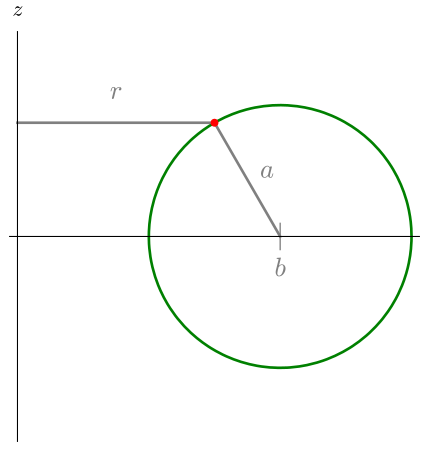
Looking at the slice of the torus shown by the grey plane in FigureΒ 13.10.4 reveals a two-dimensional plot as shown in FigureΒ 13.10.5. Points on the circle are described in \(r\) and \(z\) in terms of the parameter \(s\text{.}\) The green circle in the \(rz\)-plane is described by \(r(s)=b+a \cos(s)\) and \(z(s)=\sin(s)\) with \(0\leq s \leq 2\pi\text{.}\) This is a typical parameterization of a circle with a horizontal translation by \(a\text{.}\)
described in detail following the image
The right half of a two-dimensional plane in which the verticla axes is labeled \(z\text{.}\) A circle of radius \(a\) centered at the point \((b,0)\) is shown. A point on the circle is highlighted. The distance from the \(z\)-axis to the point is labeled \(r\text{.}\)
Figure 13.10.5. A circle of radius \(a\) centered at the point \((b,0)\)
These cylindrical coordinate transformations lead to the \(x\text{,}\) \(y\text{,}\) and \(z\)-coordinates in terms of parameters \(s\) and \(t\text{.}\) The cylindrical coordinates of the points of the torus can be written in terms of \(s\) and \(t\) as
\begin{equation*} \theta = t, \quad r = b+a\cos(s), \quad z=a\sin(s) \end{equation*}
Therefore, the rectangular coordinates of the points on the torus can be written in terms of \(s\) and \(t\) as
\begin{align*} x \amp= r \cos(\theta) \amp= (b+a \cos(s))\cos(t)\\ y \amp= r \sin(\theta) \amp= (b+a \cos(s))\sin(t)\\ z \amp= z \amp= a \sin(s) \end{align*}
Just as in the case of parameterizing a curve in space using a vector-valued function of one variable, a parametric description of a surface requires bounds on the parameters used to describe the surface. Remember that for a point on the torus, the \(t\)-parameter describes the location in terms of rotation around the \(z\)-axis and the \(s\)-parameter describes the point’s location around the circular slice (in the \(rz\)-plane). Both the \(s\) and \(t\) parameters are bounded below by \(0\) and above by \(2 \pi\text{.}\) Therefore, a parametric description for the torus using a vector-valued function of two variables can be written as
\begin{align*} \vr (s,t) =& \langle x(s,t),y(s,t),z(s,t)\rangle \\ =& \langle \left(b+a \cos(s)\right)\cos(t), \left(b+a \cos(s)\right)\sin(t), a \sin(s) \rangle \end{align*}
for \(s,t \in [0,2 \pi)\text{.}\)
The next activity finds two ways to parameterize a sphere centered at the origin. The first views the sphere as a surface of revolution around the \(z\)-axis, similar to the preceding example. The second uses spherical coordinates.

Activity 13.10.2.

The goal of this activity is to find a parametrization of the sphere of radius \(R\) centered at the origin, as shown in FigureΒ 13.10.6. Check the box at the top of the plot to highlight what a semicircular slice of the sphere looks like along a slice with a constant \(\theta\) coordinate. Notice that this slice shows how the sphere can be made by rotating this half circle around the \(z\)-axis.
An interactive three dimensional plot that shows axes labeled \(x\text{,}\) \(y\text{,}\) and \(z\text{.}\) A sphere centered at the origin is shown. A checkbox above the interactive plot toggles a half circle plotted along the sphere from the positive \(z\)-axis to the negative \(z\)-axis.
Figure 13.10.6. A plot of a sphere of radius \(R\) centered at the origin

(a)

One approach to parameterizing the sphere of radius \(R\) is similar to the approach to parameterizing the torus as a surface of revolution around the \(z\)-axis. In other words, let the parameter \(t\) represent the location as a rotation around the \(z\)-axis. This allows for parameterization the sphere as
\begin{equation} x(s,t)= r(s) \cos(t) , \quad y(s,t)=r(s) \sin(t), \quad z(s,t)= z(s) \text{,}\tag{13.10.1} \end{equation}
where \(r(s)\) and \(z(s)\) describe the other cylindrical coordinates in terms of another parameter.
described in detail following the image
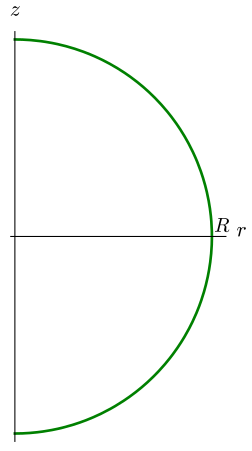
A two dimensional plot with horizontal axis labeled \(r\) and vertical axis labeled \(z\text{.}\) The right half of a circle centered at the origin is shown in green and its radius is labeled \(R\text{.}\)
Figure 13.10.7. A plot of a half circle in the \(rz\)-plane representing the slice of the sphere rotated around the \(z\)-axis
We want to describe the points on the green half circle shown in FigureΒ 13.10.7 in terms of the parameter \(s\text{.}\) Remember that there is not a unique way to parameterize a curve. Give a parameterization of the green half circle in FigureΒ 13.10.7 as a function of the parameter \(s\text{.}\) Be sure to state the bounds on \(s\text{.}\)
Hint.
Think of the sphere as a surface of rotation and write \(r\) as a function of \(z\text{.}\) In other words, how large is the radius of the revolution around the \(z\)-axis in terms of the \(z\) coordinate?

(b)

Combine your answer to the previous part with (13.10.1) to create a parameterization of the sphere of radius \(R\text{.}\) Substitute your answer for the previous part into (13.10.1), writing your answer as parametric functions for \(x\text{,}\) \(y\text{,}\) and \(z\text{.}\) Be sure to state the bounds on the parameters \(s\) and \(t\text{.}\)
\begin{align*} x(s,t) \amp= \fillinmath{XXXXX}\\ y(s,t) \amp= \fillinmath{XXXXX}\\ z(s,t) \amp= \fillinmath{XXXXX}\\ \fillinmath{XX}\amp\leq s \leq\fillinmath{XX}\\ \fillinmath{XX}\amp\leq t \leq\fillinmath{XX} \end{align*}

(c)

Use FigureΒ 13.10.8 to verify that your parameterization for the previous part plots the sphere of radius 3 centered at the origin. Remember to adjust the upper and lower bounds of \(s\) and \(t\) to match your parameterization.
A three-dimensional plotting interactive tool. Functions for \(x\text{,}\) \(y\text{,}\) and \(z\) in terms of the parameters \(s\) and \(t\) as well as bounds on the parameters are entered.
Figure 13.10.8. An interactive plot where readers can input their parameterization and bounds

(d)

Next we use spherical coordinates to create a parameterization of the sphere of radius \(R\text{.}\) We want to express the rectangular coordinate equation \(x^2+y^2+z^2=R^2\) in spherical coordinates. State an equation in spherical coordinates that describes the same set of points as \(x^2+y^2+z^2=R^2\text{.}\)
Hint.
This equation is of the form \(\rho= \text{constant}\)

(e)

Surfaces of the form \(z=f(x,y)\) were easily parameterized because each of the coordinates can be expressed in terms of two variables: \(x\) and \(y\text{.}\) We can apply a similar idea here because in spherical coordinates, the sphere has one spherical coordinate fixed and the other two spherical coordinates can be used as parameters. Write a couple of sentences to describe which spherical coordinate \(s\) will act as and which coordinate \(t\) will act as. Include bounds on these parameters as part of your descriptions.

(f)

To create a spherical coordinate parameterization of \(x^2+y^2+z^2=R^2\text{,}\) substitute the constant value for the appropriate spherical coordinate and \(s\) or \(t\text{,}\) as determined by your choices in the previous part, for the other two spherical coordinates into the following transformation equations:
\begin{equation*} x=\rho \cos(\theta) \sin(\phi) \quad \quad y=\rho \sin(\theta) \sin(\phi) \quad \quad z=\rho \cos(\phi) \end{equation*}
This gives equations for \(x\text{,}\) \(y\text{,}\) and \(z\) in terms of the parameters \(s\) and \(t\text{,}\) as well as bounds on both \(s\) and \(t\text{:}\)
\begin{equation*} x(s,t) = \fillinmath{XXXXX} \quad y(s,t) = \fillinmath{XXXXX} \quad z(s,t)=\fillinmath{XXXXX} \end{equation*}
with the bounds on \(s\) and \(t\) given by
\begin{equation*} \fillinmath{XX} \leq s \leq \fillinmath{XX} \text{ and } \fillinmath{XX} \leq t \leq \fillinmath{XX} \text{.} \end{equation*}
The previous activity demonstrates that it is sometimes possible to parameterize a surface in multiple ways. The parameterizations for the sphere in the activity depended on whether you viewed the sphere as a surface of revolution or whether you used spherical coordinates. There are many other ways to parameterize a sphere, but these are likely the two most familiar and common ideas.
This section’s exercises ask you to generate and understand the parameterization of the quadric surfaces and cylinder surfaces described in SectionΒ 9.8. Additionally, the exercises ask you to understand how shifts and stretches can be applied to each rectangular coordinate separately.

Subsection 13.10.3 The Geometry of a Parametric Surface

The parameterization of a surface allows us to access important geometric information about the surface. In this subsection, we consider a surface \(S_1\text{,}\) given by a parameterization \(\vr(s,t)=\langle x(s,t), y(s,t), z(s,t) \rangle \) with \(a \leq s \leq b\) and \(c \leq t \leq d\text{.}\)
In SubsectionΒ 11.2.4, we considered a function \(f(x,y)\) and saw how holding one of the input coordinates constant allowed us to restrict the graph of \(z=f(x,y)\) to a single-variable slice, which we called the trace. For example, we looked at the trace along \(x=a\text{,}\) which is given by \(z=f(a,y)\text{.}\) Refer to FigureΒ 11.2.11 for an illustration of this. Focusing on a single slice allowed us to define partial derivatives and many other tools in ChapterΒ 11.
What happens when we hold a parameter for a parametric surface constant and allow the other to vary? This gives a slice of the parametric surface, but the slice is not necessarily in the direction of one of the coordinates (\(x\text{,}\) \(y\text{,}\) or \(z\)). Instead, the slice describes the surface in a constant direction of one parameters, \(s\) or \(t\text{.}\) The trace given by holding \(s\) constant yields \(\vr(a,t)\text{,}\) a curve parameterized as a vector-valued function of one variable. This allows the use of the tools from ChapterΒ 10 to understand this curve. Specifically, the derivative,
\begin{equation*} \frac{d\vr}{dt} (a,t)=\langle \frac{dx}{dt}(a,t),\frac{dy}{dt}(a,t),\frac{dz}{dt}(a,t)\rangle \end{equation*}
gives a vector that is tangent to the curve given by \(\vr(a,t)\text{.}\) Similarly, we can look at the trace generated in the direction of a constant value of \(t\text{.}\) This gives a trace parameterized as \(\vr(s,b)\) with a tangent vector \(\frac{d\vr}{ds}(s,b)\text{.}\)
FigureΒ 13.10.9 shows plot of a parametric surface given by \(\vr(s,t)\) for \(s_1 \leq s \leq s_2\) and \(t_1 \leq t \leq t_2\) plotted as a light blue surface. There are five constant values of \(t\) plotted along the surface in shown by the magenta curves and five constant values of \(s\) plotted along the surface as shown by the yellow curves. The tangent vectors given by \(\frac{d\vr}{ds} (s,b)\) and \(\frac{d\vr}{dt} (a,t)\) are shown at a particular point on the surface. Use the sliders at the top of FigureΒ 13.10.9 to change the location at which the tangent vectors are shown.
An interactive three-dimensional plot of a curved surface that is parabolic in one coordinate direction and cubic in the other. A grid of magenta and yellow traces along the surface are drawn. Two sliders at the top of the figure allow the user to change the location of a highlighted point on the surface. At the highlighted point, a vector is shown in magenta that is tilted to be tangent to the magenta trace through the highlighted point. A yellow vector is also drawn tangent to the yellow trace through the highlighted point. A yellow parallelogram is drawn with sides given by the magenta and yellow vectors.
Figure 13.10.9. A three-dimensional plot of a parametric surface with traces corresponding to constant \(s\) values highlighted in yellow and constant \(t\) values highlighted in magenta. The tangent vector corresponding to \(\frac{d \vr}{dt} (a,t)\) is shown with the yellow arrow and the tangent vector corresponding to \(\frac{d \vr}{ds} (s,b)\) is shown with the red arrow.
The red and yellow tangent vectors at the highlighted point allow us to describe the tangent plane at that point. A piece of the tangent plane is shown as an orange parallelogram. Note that the orange parallelogram moves and tilts to approximate the curved surface near the highlighted point. Using the properties of the cross product allows us both to compute a vector that is orthogonal to the curved surface at the highlighted point and to find the area of the orange parallelogram. (Refer to Key IdeaΒ 9.5.5 and Key IdeaΒ 9.5.6 for the original introduction of these ideas.)
We now summarize the ideas above. Notice that because \(\vr(s,t)\) is a function of two variables, we write its derivatives using partial derivative notation with respect to \(s\) or \(t\text{.}\) These partial derivatives correspond, respectively, to holding the parameter \(t\) or \(s\) constant.
  • Curves in the direction of change of \(s\) and \(t\) are given by vector-valued functions \(\vr(s,b)\) and \(\vr(a,t)\text{,}\) respectively.
  • The vectors
    \begin{equation*} \frac{\partial \vr}{\partial s}(a,b)= \vr_s(a,b)\quad \text{ and }\quad\frac{\partial \vr}{\partial t}(a,b)= \vr_t(a,b) \end{equation*}
    are tangent to the parametric surface given by \(\vr(s,t)\) through the point \(\vr(a,b)\text{.}\)
  • The vector \((\vr_s \times \vr_t)(a,b)\) is orthogonal to surface at the point \(\vr(a,b)\text{.}\) The area of the the parallelogram along the tangent plane to the surface with edges \(\vr_s(a,b)\) and \(\vr_t(a,b)\) is \(\vecmag{(\vr_s \times \vr_t)(a,b)}\text{.}\)

Example 13.10.10.

Recall the parameterization of the torus from ExampleΒ 13.10.2 given by:
\begin{align*} \vr (s,t) =& \langle x(s,t),y(s,t),z(s,t)\rangle \\ =& \langle (b+a \cos(s)) \cos(t), (b+a \cos(s)) \sin(t), a \sin(s) \rangle \end{align*}
for \(s,t \in [0,2 \pi)\text{.}\)
A torus along with tangent vectors to the traces in the \(s\)- and \(t\)-directions at the point determined by the sliders. Also shown at that point are are a vector orthogonal to the torus and a parallelogram-shaped patch of the tangent plane.
Figure 13.10.11. A torus along with tangent vectors to the traces in the \(s\)- and \(t\)-directions at the point determined by the sliders. Also shown at that point are are a vector orthogonal to the torus and a parallelogram-shaped patch of the tangent plane.
  • Fixing \(t=t_0\) gives the parameterized curve \(\vr(s,t_0)= \langle (b+a \cos(s)) \cos(t_0), (b+a \cos(s)) \sin(t_0), a \sin(s) \rangle\text{.}\) These are the traces with constant values of \(t\) and are shown in magenta in FigureΒ 13.10.11.
  • Simmilarly, the traces with constant values of \(s=s_0\) are shown in yellow in FigureΒ 13.10.11. They are parameterized by \(\vr(s_0,t)= \langle (b+a \cos(s_0)) \cos(t), (b+a \cos(s_0)) \sin(t), a \sin(s_0) \rangle\text{.}\)
  • The vector tangent to the surface along the trace with constant \(t\)-value is
    \begin{equation*} \vr_s=\langle (-a\sin(s))\cos(t), (-a\sin(s))\sin(t),0\rangle\text{.} \end{equation*}
    This vector is shown by the magenta arrow in FigureΒ 13.10.11.
  • The vector tangent to the surface along the trace with constant \(s\)-value is
    \begin{equation*} \vr_t=\langle (a+b\cos(s))(-\sin(t)),(a+b\sin(s))(\cos(t)),0 \rangle\text{.} \end{equation*}
    This vector is shown by the yellow arrow in FigureΒ 13.10.11.
  • The green vector in FigureΒ 13.10.11 is calculated by \(\vr_s \times \vr_t\text{.}\) This vector is orthogonal to the surface at the highlighted point. The length of the green vector corresponds to the area of the orange parallelogram, which lies in the tangent plane to the torus at the point. Notice that as the length of the yellow vector increases, the parallelogram’s area and the length of the green vector both increase correspondingly.
It may have seemed unusual for us to draw attention to the area of the parallelogram formed by the tangent vectors to the trace curves in the discussion above. However, the final subsection will demonstrate how this property can be used to understand a property of the larger surface.

Subsection 13.10.4 The Surface Area of Parametrically Defined Surfaces

We are now ready to use the classic calculus approach to compute the surface area of a surface. For step one of the classic calculus approach, we break the parametrized surface into pieces corresponding to a grid of \(s\)- and \(t\)-steps as shown in FigureΒ 13.10.12. On each of these pieces of the \(st\)-grid, we approximate the surface with a parallelogram tangent to the surface at that point. The sum of the areas of these parallelograms gives an approximation of the area of the surface. In step two of the classic calculus approach, we consider smaller step sizes in \(s\) and \(t\) as part of the sum used in the approximation. The third step of the classic calculus approach is a limit of the surface area approximation which leads to a double Riemann sum that corresponds to a double integral.
An interactive plot of a curved surface shown in blue. A slider at the top of the figure allows the user to change the number of sections for the grid shown on the surface. At the top right of each grid piece along the surface a yellow parallelogram is drawn over each grid piece such that the parallelogram is tangent to the surface on the grid piece. The more curved the surface is on a grid piece, the larger the parallelogram.
Figure 13.10.12. Pieces of the tangent planes used to approximate surface area

Proof.

For this development, we will use a parametrized surface given by
\begin{equation*} \vr(s,t) = x(s,t) \vi + y(s,t) \vj + z(s,t) \vk \end{equation*}
with \(a \leq s \leq b\) and \(c \leq t \leq d\text{.}\) Although we illustrate the idea using a rectangular domain in the \(st\)-plane, this same approach works for non-rectangular domains. The partial derivatives of this parameterization
\begin{align*} \vr_s(s,t) \amp = x_s(s,t) \vi + y_s(s,t) \vj + z_s(s,t) \vk\\ \vr_t(s,t) \amp = x_t(s,t) \vi + y_t(s,t) \vj + z_t(s,t) \vk \end{align*}
give vectors tangent to the surface in the direction of change in \(s\) and \(t\text{,}\) respectively.
To break the section of the surface into steps in \(s\) and \(t\text{,}\) we partition the interval of \(s\)-values \([a,b]\) into \(m\) subintervals of length \(\Delta s = \frac{b-a}{m}\) and let \(s_0\text{,}\) \(s_1\text{,}\) \(\ldots\text{,}\) \(s_m\) be the endpoints of these subintervals, where \(a = s_0\lt s_1\lt s_2 \lt \cdots \lt s_m = b\text{.}\) We also partition the interval of \(t\)-values \([c,d]\) into \(n\) subintervals of equal length \(\Delta t = \frac{d-c}{n}\) and let \(t_0\text{,}\) \(t_1\text{,}\) \(\ldots\text{,}\) \(t_n\) be the endpoints of these subintervals, where \(c = t_0\lt t_1\lt t_2 \lt \cdots \lt t_n = d\text{.}\)
These subintervals partition the rectangle \(R\) with \(a\leq s\leq b\) and \(c\leq t\leq d\) in \(st\)-coordinates into \(mn\) sub-rectangles \(R_{ij}\) with opposite vertices \((s_{i-1},t_{j-1})\) and \((s_i, t_j)\) for \(i\) between \(1\) and \(m\) and \(j\) between \(1\) and \(n\text{.}\) These rectangles all have equal area \(\Delta A = \Delta s \cdot \Delta t\text{.}\)
Each of these rectangles from the \(st\)-domain splits the surface into an \(m\times n\) grid of patches, but these patches of the surface do not all have the same (surface) area. FigureΒ 13.10.9 shows a surface with traces given for five equally-spaced values of \(s\) and \(t\text{.}\) This breaks the surface into a \(4\times 4\) grid of patches. Since these patches of the surface do not have the same surface area, we estimate the surface area for each particular piece of the grid using the tools from the parameterization.
Each of the pieces of the surface corresponds to increasing \(s\) by a small amount \(\Delta s\) or increasing \(t\) by a small amount \(\Delta t\) from the point \((s_{i-1},t_{j-1})\) in the \(st\)-parameter plane. We want to find the vectors corresponding to each of the sides of the orange parallelogram in FigureΒ 13.10.9. In particular, the vector \(\vr_t \Delta t\) corresponds to the side of the parallelogram along a constant value of \(s\) (shown as a yellow vector in FigureΒ 13.10.9) and \(\vr_s \Delta s\) corresponds to the side of the parallelogram along a constant value of \(t\) (shown as a red vector in FigureΒ 13.10.9).
The area of this parallelogram is \(S_{ij}=\vecmag{(\vr_s \Delta s) \times (\vr_t \Delta t)}\) evaluated at the point \((s_{i-1},t_{j-1})\text{.}\) This is an approximation of the surface area for a patch of the surface. The magnitude simplifies to \(S_{ij}=\vecmag{\vr_s \times \vr_t} \Delta s \Delta t\text{,}\) which means that the approximation over all of these pieces of the grid sums to
\begin{equation} SA\approx \sum_{i=1}^m \sum_{j=1}^n S_{ij}= \sum_{i=1}^m \sum_{j=1}^n \vecmag{\vr_s(s_{i-1},t_{j-1}) \times \vr_t(s_{i-1},t_{j-1})} \Delta s \Delta t\text{.}\tag{13.10.3} \end{equation}
We have now completed both the first and second steps of the classic calculus approach by approximating the surface area and quantifying how the approximation changes with a smaller scale of steps (in \(s\) and \(t\)). You can use FigureΒ 13.10.12 to see how increasing the number of pieces gives successively better approximations for the surface area of each piece.
Note that this approximation is a double Riemann sum corresponding to a double integral. In particular, taking the limit as \(\Delta s\) and \(\Delta t\) go to zero, the Riemann sum becomes a double integral of \(\vecmag{\vr_s \times \vr_t}\) over the rectangular region of integration with \(a \leq s \leq b\) and \(c \leq t \leq d\text{,}\) which gives the following formula for calculating the surface area.
Our next example shows how to calculate the surface area of sphere using Key IdeaΒ 13.10.13 applied to the parameterizations of the sphere from ActivityΒ 13.10.2.

Example 13.10.14.

Recall that in ActivityΒ 13.10.2, we found two parameterizations for the sphere of radius \(R\) centered at the origin. We will now explore how those parameterizations and Key IdeaΒ 13.10.13 can be used to find the surface area of this sphere. The first approach to parameterizing the sphere was to consider the sphere as a surface of revolution around the \(z\)-axis. This gave the parameterization
\begin{equation*} \vr(s,t) = \langle \sqrt{R^2-s^2}\cos(t), \sqrt{R^2-s^2}\sin(t), s \rangle \end{equation*}
with \(s\) acting as the \(z\)-coordinate, ranging from \(R\) to \(-R\text{,}\) and \(t\) acting as \(\theta\text{,}\) ranging from \(0\) to \(2\pi\text{.}\)
We calculate \(\vr_s, \vr_t, \vecmag{\vr_s \times \vr_t}\) as follows:
\begin{align*} \vr_s \amp= \left\langle \frac{-2s}{\sqrt{R^2-s^2}}\cos(t), \frac{-2s}{\sqrt{R^2-s^2}}\sin(t), 1 \right\rangle\\ \vr_t \amp= \left\langle -\sqrt{R^2-s^2}\sin(t), \sqrt{R^2-s^2}\cos(t), 0 \right\rangle\\ \vr_s \times \vr_t \amp= \left\langle -\sqrt{R^2-s^2} \cos(t), -\sqrt{R^2-s} \sin(t), -\frac{2s}{\sqrt{R^2-s^2}} \right\rangle \\ \vecmag{\vr_s \times \vr_t} \amp= \sqrt{(R^2-s^2) \cos^2(t)+(R^2-s) \sin^2(t)+ \frac{4s^2}{R^2-s^2}} \end{align*}
Unfortunately, this expression for \(\vecmag{\vr_s \times \vr_t}\) does not simplify much more. This gives us the surface area double integral
\begin{equation*} \int_{-R}^R \int_0^{2\pi} \sqrt{(R^2-s^2)+ \frac{4s^2}{R^2-s^2}} dt \, ds \text{.} \end{equation*}
While this integral can be evaluated, it requires a trigonometric substitution. We will omit the calculations that result from this and turn to our other parameterization for an easier calculation of the surface area.
Recall the parameterization of the sphere that came from using spherical coordinates:
\begin{equation*} \vr(s,t) = \langle R \sin(s) \cos(t), R \sin(s)\sin(t), R\cos(s) \rangle \end{equation*}
with \(s\) acting as the \(\phi\)-coordinate, ranging from \(0\) to \(2\pi\text{,}\) and \(t\) acting as the \(\theta\text{,}\) ranging from \(0\) to \(2\pi\text{.}\)
We calculate \(\vr_s, \vr_t, \vecmag{\vr_s \times \vr_t}\) as follows:
\begin{align*} \vr_s \amp= \langle R \cos(s) \cos(t), R \cos(s)\sin(t), -R\sin(s) \rangle\\ \vr_t \amp= \langle -R \sin(s) \sin(t), R \sin(s) \cos(t), 0 \rangle\\ \vr_s \times \vr_t \amp= \langle R^2 \sin^2(s) \cos(t), R^2 \sin^2(s) \sin(t), R^2 \cos^2(t) \cos(s)\sin(s)+R^2 \sin^2(t) \cos(s)\sin(s) \rangle \\ \amp= R^2\sin(s) \langle \sin(s) \cos(t), \sin(s) \sin(t), \cos(s) \rangle \\ \vecmag{\vr_s \times \vr_t} \amp= R^2\sin(s) \end{align*}
You may recognize this expression from our work on the volume element in spherical coordinates, Key IdeaΒ 12.8.5. In both this case and the volume element of spherical coordinates, we are measuring how warped our space is based on transformations using spherical coordinates.
The surface area double integral is
\begin{equation*} \int_{0}^\pi \int_0^{2\pi} R^2\sin(s) dt \, ds \text{,} \end{equation*}
which evaluates to
\begin{equation*} R^2 (2 \pi) \left[-\cos(s)\restrict{s=0}{s=\pi}\right]= R^2 (2 \pi)(2)=4\pi R^2\text{,} \end{equation*}
the familiar formula for the surface area of a sphere for which you likely previously had no explanation.

Activity 13.10.3.

This activity computes the surface area of a right circular cylinder. In particular, consider the cylinder with radius \(a\) and height \(h\) defined parametrically by
\begin{equation*} \vr(s,t) = a\cos(s) \vi + a\sin(s) \vj + t \vk \end{equation*}
for \(0 \leq s \leq 2\pi\) and \(0 \leq t \leq h\text{,}\) as shown in FigureΒ 13.10.15.
described in detail following the image
A portion of a cylindrical surface in three-dimensional space. The cylinder is about the \(z\)-axis and has radius \(a\text{.}\) The height of the cylinder is marked as \(h\text{,}\) with the bottom of the cylinder sitting on the \(xy\)-plane.
Figure 13.10.15. A part of the cylinder of radius \(a\) about the \(z\)-axis

(a)

Calculate \(\vr_s, \vr_t, \vecmag{\vr_s \times \vr_t}\) based on the parameterization given above.

(b)

Use the calculations from the previous part to set up an iterated integral to determine the surface area of this cylinder.

(d)

One way to think about the surface area of a cylinder is to cut the cylinder horizontally and find the perimeter of the resulting cross sectional circle, then multiply by the height. Calculate the surface area of the given cylinder using this alternate approach, and compare your result the value from the previous part.
As we noted earlier, we can take any surface \(z = f(x,y)\) and obtain a parameterization for the surface by writing \(\langle s, t, f(s,t) \rangle\text{.}\) Hence, we can use Key IdeaΒ 13.10.13 to find the area of a surface \(z = f(x,y)\) over a given domain.

Activity 13.10.4.

Let \(z = f(x,y)\) define a smooth surface, and consider the parameterization \(\vr(s,t) = \langle s, t, f(s,t) \rangle\text{.}\)

(a)

Let \(D\) be a region in the domain of \(f\text{.}\) Using equationΒ (13.10.2), show that the area of the surface defined by the graph of \(f\) over \(D\) is
\begin{equation*} \iint_D \sqrt{\left(f_x(x,y)\right)^2 + \left(f_y(x,y)\right)^2 + 1} \ dA\text{.} \end{equation*}

(b)

Use the formula developed in the previous part to calculate the area of the surface defined by \(f(x,y) = \sqrt{4-x^2}\) over the rectangle \(D = [-2,2] \times [0,3]\text{.}\)

(c)

Observe that the surface of the solid describe the previous part is half of a circular cylinder. Use the standard formula for the surface area of a cylinder to calculate the surface area in a different way, and compare your result from above.

Exercises 13.10.5 Exercises

1.

Consider the cone shown below.
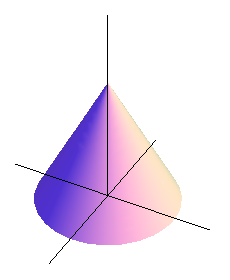
A plot of a cone surface with vertex on the z-axis
figure of a cone with circular base on the xy-plane, centered on the z-axis, and point on the positive z-axis.
If the height of the cone is 6 and the base radius is 5, write a parameterization of the cone in terms of \(r = s\) and \(\theta = t\text{.}\)
\(x(s,t) =\) ,
\(y(s,t) =\) , and
\(z(s,t) =\) , with
\(\le s\le\) and
\(\le t\le\) .

2.

Parameterize a vase formed by rotating the curve \(z= 6 \sqrt{x-2},\,2\leq x\leq 4\text{,}\) around the \(z\)-axis. Use \(s\) and \(t\) for your parameters.
\(x(s,t) =\) ,
\(y(s,t) =\) , and
\(z(s,t) =\) , with
\(\le s\le\) and
\(\le t\le\)

3.

Find parametric equations for the sphere centered at the origin and with radius 7. Use the parameters \(s\) and \(t\) in your answer.
\(x(s,t) =\) ,
\(y(s,t) =\) , and
\(z(s,t) =\) , where
\(\le s\le\) and
\(\le t\le\) .

4.

Match the parametric equations with the verbal descriptions of the surfaces by putting the letter of the verbal description to the left of the letter of the parametric equation.
  1. \(\displaystyle \mathbf{r} \left( u, v \right) = u \cos v \mathbf{i} + u \sin v \mathbf{j} + u^{2} \mathbf{k}\)
  2. \(\displaystyle \mathbf{r} \left( u, v \right) = u \mathbf{i} + \cos v \mathbf{j} + \sin v \mathbf{k}\)
  3. \(\displaystyle \mathbf{r} \left( u, v \right) = u \mathbf{i} + u \cos v \mathbf{j} + u \sin v \mathbf{k}\)
  4. \(\displaystyle \mathbf{r} \left( u, v \right) = u \mathbf{i} + v \mathbf{j} + \left( 2u - 3v \right) \mathbf{k}\)
  1. circular paraboloid
  2. circular cylinder
  3. plane

5.

Parameterize the plane that contains the three points
(4,-3,4), (-2,-6,-6), (5,35,10).
Use s and t for the parameters in your parameterization and enter your formula as a single vector, with angle brackets, for example, \(\displaystyle{\langle 1 + s + t, s - t, 3 - t \rangle}\text{.}\) Each component should be a function of the form a+bs+ct where a,b,c are appropriate real numbers.
\(\vec{r}(s,t)\) =

6.

Find the surface area of that part of the plane \(10 x + 9 y + z = 4\) that lies inside the elliptic cylinder \(\frac{x^2}{16} + \frac{y^2}{9} =1\)
Surface Area =

7.

Find the surface area of the part of the circular paraboloid \(z = x^{2} + y^{2}\) that lies inside the cylinder \(x^{2} + y^{2} = 1\text{.}\)

8.

Find the surface area of the part of the plane \(1 x + 1 y + z = 1\) that lies inside the cylinder \(x^{2} + y^{2} = 9\text{.}\)

9.

Write down the iterated integral which expresses the surface area of \(z = y^{3}\cos^{7}x\) over the triangle with vertices (-1,1), (1,1), (0,2):
\begin{equation*} \int_a^b\int_{f(y)}^{g(y)} \sqrt{h(x,y)}\,dx dy \end{equation*}
\(a =\)
\(b =\)
\(f(y) =\)
\(g(y) =\)
\(h(x,y) =\)

10.

A decorative oak post is 48 inches long and is turned on a lathe so that its profile is sinusoidal as shown in the figure below.
A column that has a sinusoidal radius
figure of a column with a vertically varying outside radius. the maximum radius is r0 inches, the vertical distance between maximum radii is a0 inches, and the difference between the minimum and maximum radii is 2 inches.
In this figure, \(r_0 = 4\) inches and \(a_0 = 8\) inches.
(a) Describe the surface of the post parametrically using cylindrical coordinates and the parameters \(s\) and \(t\text{.}\)
\(x(s,t) =\) ,
\(y(s,t) =\) , and
\(z(s,t) =\) , where
\(\le s\le\) and
\(\le t\le\) .
(b) Find the volume of the post.
volume =
(Include .)

11.

Find the surface area of the part of the sphere \(x^{2} + y^{2} + z^{2} = 25\) that lies above the cone \(z = \sqrt{x^{2} + y^{2}}\)

12.

If a parametric surface given by \(\mathbf{r_{1}}(u, v) = f(u, v)\mathbf{i} + g(u, v)\mathbf{j} + h(u, v)\mathbf{k}\) and \(-4 \leq u \leq 4, -4 \leq v \leq 4\text{,}\) has surface area equal to 4, what is the surface area of the parametric surface given by \(\mathbf{r_{2}}(u, v) = 3\mathbf{r_{1}}(u, v)\) with \(-4 \leq u \leq 4, -4 \leq v \leq 4\text{?}\)

13.

Write down the iterated integral which expresses the surface area of \(z = y^{6}\cos^{4}x\) over the triangle with vertices (-1,1), (1,1), (0,2):
\begin{equation*} \int_a^b\int_{f(y)}^{g(y)} \sqrt{h(x,y)}\,dx dy \end{equation*}
\(a =\)
\(b =\)
\(f(y) =\)
\(g(y) =\)
\(h(x,y) =\)

14.

Find the area of the portion of the sphere of radius 9 (centered at the origin) that is in the cone \(z > \sqrt{x^2 + y^2}\text{.}\)

15.

Find the surface area of the part of the plane \(5 x + 4 y + z = 1\) that lies inside the cylinder \(x^{2} + y^{2} = 16\text{.}\)

16.

Find the surface area of the part of the circular paraboloid \(z = x^{2} + y^{2}\) that lies inside the cylinder \(x^{2} + y^{2} = 1\text{.}\)

17.

Find the area of the surface obtained by rotating the curve
\begin{equation*} y = 2x^{3} \end{equation*}
from \(x = 0\) to \(x = 1\) about the \(x\)-axis.
The area is square units.

18.

The vector equation \(\mathbf{r} \left( u, v \right) = u \cos v \mathbf{i} + u \sin v \mathbf{j} + v \mathbf{k}\text{,}\) \(0 \leq v \leq 3 \pi\text{,}\) \(0 \leq u \leq 1\text{,}\) describes a helicoid (spiral ramp). What is the surface area?

19.

Find the surface area of the portion \(S\) of the cone \(z^2=x^2+y^2\text{,}\) where \(z\ge 0\text{,}\)
contained within the cylinder \(y^2+z^2\le 25\text{.}\)
\(\mathrm{Area}(S)=\)

20.

A torus of radius 6 (and cross-sectional radius 1) can be represented parametrically by the function \(\mathbf{r}: D \to \mathbb{R}^3\text{:}\)
\begin{equation*} \mathbf{r}(\theta, \phi) = ((6 + \cos\phi)\cos\theta,(6 + \cos\phi)\sin\theta, \sin\phi) \end{equation*}
where D is the rectangle given by \(0\le \theta \le 2\pi, \ 0\le \phi \le 2\pi\text{.}\)
The surface area of the torus is

21.

Find an equation of the tangent plane (in the variables x, y and z) to the parametric surface
\(\mathbf{r}(u,v) = \langle u, u^2 + 5v, -5v^2 \rangle\) at the point \((-2, 4, 0)\text{.}\)

22.

Calculate \({\mathbf{T}}_u\text{,}\) \({\mathbf{T}}_v\text{,}\) and \(\mathbf{n}(u,v)\) for the parametrized surface at the given point.
Then find the equation of the tangent plane to the surface at that point.
\(\Phi(u,v)= (2u+v,u-4v,8 u)\text{;}\)\(\qquad u=4\text{,}\quad v=9\)
\({\mathbf{T}}_u=\) , \({\mathbf{T}}_v=\) , \(\mathbf{n}(u,v)=\)
The tangent plane:
\(=9z\)

23.

Consider the ellipsoid given by the equation
\begin{equation*} \frac{x^2}{16} + \frac{y^2}{25} + \frac{z^2}{9} = 1. \end{equation*}
In ActivityΒ 13.10.2, we found that a parameterization of the sphere \(S\) of radius \(R\) centered at the origin is
\begin{equation*} x(r,s) = R\cos(s) \cos(t), \ y(s,t) = R \cos(s) \sin(t), \ \text{ and } \ z(s,t) = R\sin(s) \end{equation*}
for \(-\frac{\pi}{2} \leq s \leq \frac{\pi}{2}\) and \(0 \leq t \leq 2\pi\text{.}\)
  1. Let \((x,y,z)\) be a point on the ellipsoid and let \(X = \frac{x}{4}\text{,}\) \(Y = \frac{y}{5}\text{,}\) and \(Z = \frac{z}{3}\text{.}\) Show that \((X,Y,Z)\) lies on the sphere \(S\text{.}\) Hence, find a parameterization of \(S\) in terms of \(X\text{,}\) \(Y\text{,}\) and \(Z\) as functions of \(s\) and \(t\text{.}\)
  2. Use the result of part (a) to find a parameterization of the ellipse in terms of \(x\text{,}\) \(y\text{,}\) and \(z\) as functions of \(s\) and \(t\text{.}\) Check your parametrization by substituting \(x\text{,}\) \(y\text{,}\) and \(z\) into the equation of the ellipsoid. Then check your work by plotting the surface defined by your parameterization.

24.

In this exercise, we explore how to use a parametrization and iterated integral to determine the surface area of a sphere.
  1. Set up an iterated integral whose value is the portion of the surface area of a sphere of radius \(R\) that lies in the first octant (see the parameterization you developed in ActivityΒ 13.10.2).
  2. Then, evaluate the integral to calculate the surface area of this portion of the sphere.
  3. By what constant must you multiply the value determined in (b) in order to find the total surface area of the entire sphere.
  4. Finally, compare your result to the standard formula for the surface area of sphere.

25.

Consider the plane generated by \(z = f(x,y) = 24 - 2x - 3y\) over the region \(D = [0,2]\times[0,3]\text{.}\)
  1. Sketch a picture of the overall solid generated by the plane over the given domain.
  2. Determine a parameterization \(\vr(s,t)\) for the plane over the domain \(D\text{.}\)
  3. Use EquationΒ (13.10.2) to determine the surface area generated by \(f\) over the domain \(D\text{.}\)
  4. Observe that the vector \(\vu = \langle 2, 0, -4 \rangle\) points from \((0,0,24)\) to \((2,0,20)\) along one side of the surface generated by the plane \(f\) over \(D\text{.}\) Find the vector \(\vv\) such that \(\vu\) and \(\vv\) together span the parallelogram that represents the surface defined by \(f\) over \(D\text{,}\) and hence compute \(| \vu \times \vv |\text{.}\) What do you observe about the value you find?

26.

A cone with base radius \(a\) and height \(h\) can be realized as the surface defined by \(z = \frac{h}{a} \sqrt{x^2+y^2}\text{,}\) where \(a\) and \(h\) are positive.
  1. Find a parameterization of the cone described by \(z = \frac{h}{a} \sqrt{x^2+y^2}\text{.}\) (Hint: Compare to the parameterization of a cylinder as seen in ActivityΒ 13.10.3.)
  2. Set up an iterated integral to determine the surface area of this cone.
  3. Evaluate the iterated integral to find a formula for the lateral surface area of a cone of height \(h\) and base \(a\text{.}\)

27.

Parameterize the following surfaces and be sure to state bounds for your parameterization.

(c)

\(\left(\frac{x-2}{3}\right)^2+\left(\frac{y+2}{1}\right)^2+\left(\frac{z-1}{5}\right)^2=1\)

(e)

\(\left(\frac{x-2}{3}\right)^2-\left(\frac{y+2}{1}\right)^2-\left(\frac{z-1}{5}\right)^2=1\)

(f)

\(\left(\frac{x-2}{3}\right)^2-\left(\frac{y+2}{1}\right)^2+\left(\frac{z-1}{5}\right)^2=1\)

(h)

\(\left(\frac{x-2}{3}\right)^2-\left(\frac{y+2}{1}\right)^2-\left(\frac{z-1}{5}\right)^2=1\)

(i)

\(z=\left(\frac{x}{2}\right)^2-\left(\frac{y}{3}\right)^2\)